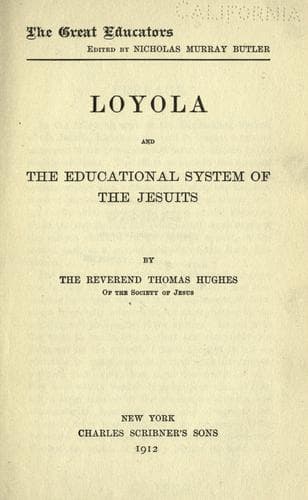
Loyola and the Educational System of the JesuitsHughes, Thomas
History
Loyola and the Educational System of the Jesuits
Hughes, Thomas
Education -- History; Ignatius, of Loyola, Saint, 1491-1556; Jesuits
This instrument for the expression of philosophical thought possesses
the qualities of subtlety, keenness, and precision, which the dialectic
practice of all universities had tended to develop in it, from the
twelfth century onwards. With the addition of Cicero's fulness and
richness, which the colleges cultivated with so much ardor, the
scholastic Latin of men like Molina, Ripalda, Liberatore, Franzelin,
and so many others, has flourished to a degree of literary excellence.
Mathematics runs parallel with the course of Philosophy, and upon
that branch of science there is a rather eloquent passage in the
_Ratio_ of 1586.[343] Physics was always included in the Aristotelian
philosophy. The career of Modern Physics was then in the future. But,
as in Mathematics pure and applied, the courses were always advanced to
the foremost rank, and in Arithmetic and Geometry we notice that, as
early as 1667, a single public course, under the direction of Jesuits
at Caen, numbered four hundred students,[344] so, in the middle of the
next century, the eighteenth, we find physical cabinets in regular
use, and experimental lectures given to the classes by the Professors
of Physics.[345] The basis of the study is thus laid down in the rules
of the revised _Ratio_: "The Professor is to expose theories, systems,
and hypotheses, so as to make it clear what degree of certitude or
probability belongs to each. Since this faculty makes new progress
every day, the Professor must consider it part of his duty to know the
more recent discoveries, so that in his prelections he may advance
with the science itself."[346] The general assemblies had legislated
on this subject, as I indicated before; assigning its proper place in
Philosophy to what they called "the more pleasant" or the "lighter"
form of Physics. Indeed, Philosophy itself in the course of three
centuries came to feel many new needs and submitted to new lines of
treatment.
=First Year.= LOGIC AND GENERAL METAPHYSICS. _One Professor: eight
hours a week._ Introductory sketch of Philosophy. Dialectics or
Minor Logic: ideas, judgment, reasoning. Logic Proper: The criteria
of truth; species of knowledge, and general rules of criticism and
hermeneutics. General Metaphysics or Ontology: The notions of being and
the categories. MATHEMATICS. _One Professor: six hours a week._ All
that prepares for the Physics of the following year, viz., algebra,
geometry, plane and spherical trigonometry, and conic sections. This
rapid course, in so short a time, supposes that the matter is not
entirely new, but has been studied already in the literary course.
Public-domain text, read in full here on John Shaqi.
Reviews
Reviews
No reviews yet
Be the first to share your thoughts on this work.
Elsewhere in the archive
Join the Discussion
Join the discussion
Sign in to leave a comment or review.
Sign InorCreate an account