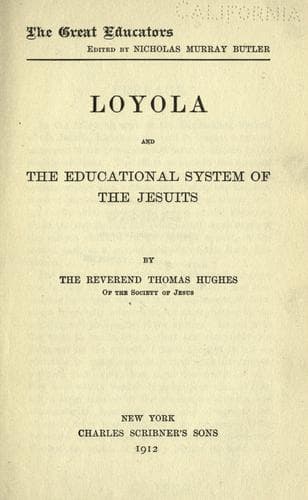
Loyola and the Educational System of the JesuitsHughes, Thomas
History
Loyola and the Educational System of the Jesuits
Hughes, Thomas
Education -- History; Ignatius, of Loyola, Saint, 1491-1556; Jesuits
RHETORIC. The grade of this class cannot easily be defined. For it
trains to perfect eloquence, which comprises two great faculties,
the oratorical and poetical, the former chiefly being the object of
culture; nor does it regard only the practical, but the beautiful
also. For the precepts, Cicero may be supplemented with Quintilian and
Aristotle. The style, which may be assisted by drawing on the most
approved historians and poets, is to be formed on Cicero; all of his
works are most fitted for this purpose, but only his speeches should
be made the subject of prelection, that the precepts of the art may be
seen in practice. As to the vernacular, the style should be formed on
the best authors. The erudition will be derived from the history and
manners of nations, from the authority of writers and all learning;
but moderately, as befits the capacity of the students. In Greek, the
fuller knowledge of authors and of dialects is to be acquired. The
Greek authors, whether orators, historians, or poets, are to be ancient
and classic: Demosthenes, Plato, Thucydides, Homer, Hesiod, Pindar, and
others of the kind, including Saints Nazianzen, Basil, and Chrysostom.
The compilers of the preliminary _Ratio_ throw out some very useful
hints, relative to the work and scope of this class. They say, for
instance, that the students of Rhetoric "are to be assisted with almost
a daily exposition of some poet, to derive thence the variety and
richness of poetic imitation and diction." Again, "nothing dialectic is
to be made the subject of prelection in this class, since rhetoricians
are to be kept as far away as possible from the style, invention, and
spirit of dialectics." "Two or three years" are spoken of as spent in
this grade.[337] At any rate, "all our day-scholars or boarders[338]
should spend one year in Rhetoric before they enter on Philosophy; this
should be brought home to their parents. The others, who attend our
courses from outside,[339] should be persuaded to do the same."[340]
If they still insist upon entering the philosophical curriculum at too
early an age, special means are suggested to discountenance such a
practice.
All these five grades are evidently so connected as not to overlap one
another. Neither are they to be multiplied, except in the sense of
allowing more than a single division, when scholars are very numerous.
If all the grades cannot be maintained in any place, "the higher
ones, as far as possible, are to be kept, the lower being dispensed
with."[341]
THE PHILOSOPHICAL CURRICULUM.
With the side branches sufficiently learned, with the boy's native
talents "stimulated" or "cultivated," as the _Ratio_ frequently
expresses itself,[342] and his memory enriched with the fullest
materials for style in two languages, Latin and the vernacular, while
Greek has subsidized his culture, the student enters on the study of
Philosophy, using scholastic Latin as the vehicle of expression.
Public-domain text, read in full here on John Shaqi.
Reviews
Reviews
No reviews yet
Be the first to share your thoughts on this work.
Elsewhere in the archive
Join the Discussion
Join the discussion
Sign in to leave a comment or review.
Sign InorCreate an account