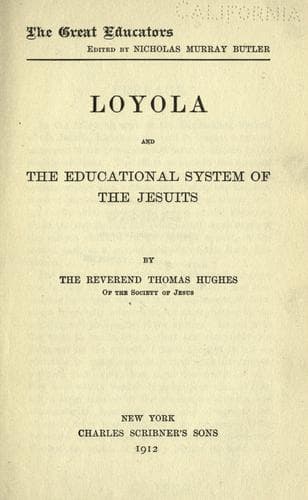
Loyola and the Educational System of the JesuitsHughes, Thomas
History
Loyola and the Educational System of the Jesuits
Hughes, Thomas
Education -- History; Ignatius, of Loyola, Saint, 1491-1556; Jesuits
"It came to a new birth in 1808, and found itself very much where
it had been, before this long sleep. Napoleon declared that the new
method of the University was very like that of the ancient University
of Paris; only that the courses 'left something to desire with regard
to drawing, modern languages, geography, history, and especially
mathematical and physical sciences.' This was progress, no doubt, and
it is well to grant it. But Napoleon is mistaken, when he pretends that
the new University is a child of the ancient one. It is preëminently
a child of the Jesuits. For, as we have remarked, the Jesuits, at the
beginning, took great care to make no innovations. They accepted, as
they found them, the old methods, introduced little by little their
own mode of procedure, an alteration most calculated to assure their
influence and their success. The grand old University which went down
to the second rank, so to say, in public education, submitted to the
influence of its detested and triumphant rivals, and, in spite of
itself, it allowed itself to be permeated by their methods. Hence, in
1808, at the moment when Napoleon dreams that he is reëstablishing the
University, the ideal of public instruction was a mixture of the old
university traditions and the empiric methods of the Jesuits."[354]
It does not come within the scope of this writer to indicate how, from
this historical point of divergence, the modern practical method of
instruction came to be fully organized. Each system went its own way. I
pass on to the other line, or rather back to the Jesuit _Ratio_; and I
will merely point out what process of adjustment it then underwent.
In 1832, Father Roothaan, General of the Society, addressed an
encyclical letter to the Order. To give an abstract of it, he says:
"In the very first assembly after the restoration of the Society, a
petition had been received from the Provinces, and daily experience
since then has shown it to be more and more necessary, that the System
of Studies should be accommodated to the exigencies of the times.
After a consultation, involving much labor and accurate study, a form
of revised _Ratio_ has been drawn up, which is now offered for use
and practice, in order that after being amended again if necessary,
or else enlarged, it may receive the sanction of a universal law. The
undertaking was approached with the greatest reverence for a System
which had been approved by two centuries of successful operation, and
which had been extolled, not unfrequently, by the very enemies of the
Order.
"Of the novelties which had been introduced into the method of
educating youth, during the last fifty years or more, was it forsooth
possible that all could be approved and adopted in our schools? New
methods and new forms invented day after day, a new arrangement
of matter and of time, often self-contradictory and mutually
repugnant--how could all this be taken as a rule for our studies?
Public-domain text, read in full here on John Shaqi.
Reviews
Reviews
No reviews yet
Be the first to share your thoughts on this work.
Elsewhere in the archive
Join the Discussion
Join the discussion
Sign in to leave a comment or review.
Sign InorCreate an account