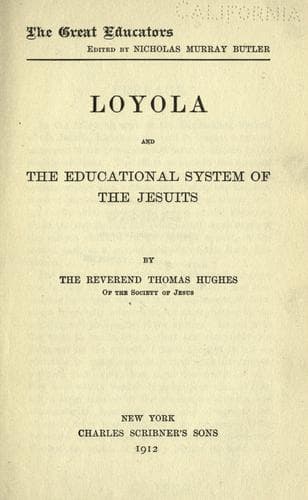
Loyola and the Educational System of the JesuitsHughes, Thomas
History
Loyola and the Educational System of the Jesuits
Hughes, Thomas
Education -- History; Ignatius, of Loyola, Saint, 1491-1556; Jesuits
"In the higher schools or in the treatment of the graver studies, it
is a subject of lamentation with prudent men that there is no solidity
but much show,--an ill-arranged mass of superfluous knowledge, very
little exact reasoning--; that the sciences, if you except Physics
and Mathematics, have not made any true progress, but are in general
confusion, so that where the final results of truth are to be found
scarcely appears. The study of Logic and severe Dialectics is almost in
contempt, whence errors come to be deeply rooted in the minds of men
who are not otherwise illiterate; and these errors, by some fatality or
other, are made much of, as if they were ascertained truths, and they
are lauded to the skies, because nothing is treated with strictness
and accuracy, no account is made of definitions and distinctness of
reasoning. Thus, tasting lightly of philosophical matters, young men go
forth utterly defenceless against sophistry, since they cannot even see
the difference between a sophism and an argument.
"In the lower schools, the object kept in view is to have boys learn as
many things as possible, and learn them in the shortest time, and with
the least exertion possible. Excellent! But that variety of so many
things and so many courses, all lightly sipped of by youth, enables
them to conceive a high opinion of how much they know, and sometimes
swells the crowd of the half-instructed, the most pernicious of all
classes to the Sciences and the State alike. As to knowing anything
truly and solidly, there is none of it. Something of everything:
nothing in the end.[355] Running through the courses of letters in no
time, tender in age, with minds as yet untrained, they take up the
gravest studies of Philosophy and the Higher Sciences; and, possessing
themselves therein of scarcely any real fruit, they are only captivated
by the enjoyment of greater liberty; they run headlong into vice, and
are soon to become teachers themselves of a type, which, to put it as
gently as possible, I will call immature.
"As to the methods, ever easier and easier, which are being
excogitated, whatever convenience may be found in them, there is this
grave inconvenience; first, that what is acquired without labor adheres
but lightly to the mind, and what is summarily gathered in is summarily
forgotten; secondly, and this, though not adverted to by many, is
a much more serious injury, almost the principal fruit of a boy's
training is sacrificed, which is, accustoming himself from an early age
to serious application of mind, and to that deliberate exertion which
is required for hard work.
"In some points, however, which do not concern the substance of
education, the necessities of our times require us to modify the
practice of our predecessors. And to consult the requirements of such
necessities, far from being alien to our principles, is altogether in
keeping with the Institute.
Public-domain text, read in full here on John Shaqi.
Reviews
Reviews
No reviews yet
Be the first to share your thoughts on this work.
Elsewhere in the archive
Join the Discussion
Join the discussion
Sign in to leave a comment or review.
Sign InorCreate an account