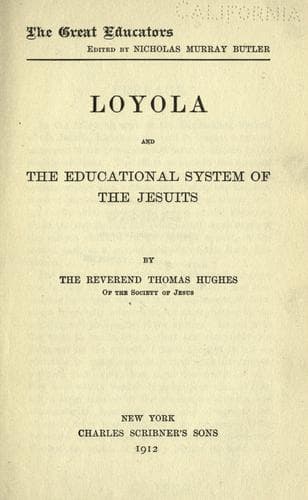
Loyola and the Educational System of the JesuitsHughes, Thomas
History
Loyola and the Educational System of the Jesuits
Hughes, Thomas
Education -- History; Ignatius, of Loyola, Saint, 1491-1556; Jesuits
So then the edifice of the past stands, with the latest modifications
introduced into its façade by the spirit of the present. As the
monumental structures which stud the soil of Europe, and are set amid
royal parks or rich fields of waving grain, have been tributes of
devotion from princes of the church or princes of the land, and are
not only the memorials of kings or peoples, but are especially the
architectural record of centuries; so a system recognized in history
as great, elevated in the order of highest human achievement, that of
educating humanity, and resting on the basis of oldest traditions and
the wisdom of the remotest past, has not been the work of an ordinary
individual, nor of a day. Masters in their art, and centuries in their
duration, have combined to build it up, a monument of the practice
and theory of generations. With devoted zeal and prudence, secular
communities, and even pagans in times far gone by, had brought the
stones, and contributed tithes to the erection of the fabric. But it is
only too well known that Ecclesiastics and Religious men have been the
architects of the monument as it stands. And they did not build better
than they knew; for their structure is precisely one of knowledge,
chiefly of divine knowledge, raised into a consistent theory, and
honored by the most practical use. So the very first sentence in the
_Ratio Studiorum_, speaking of the "abundant practical fruit to be
gathered from this manifold labor of the schools," mentions that fruit
as being "the knowledge and love of the Creator."
I may be permitted then to close this work by quoting their own poetry,
which is inscribed on a statue of Christ. The statue overlooks a park
in front of it, and the fields hard by, and the rich garden of studious
youth, within the college walls alongside. Thus one inscription
reads:--
TIBI · HAEC · ARVA · RIDENT · ATQUE · AGGERE
COMPLANATO · HAE · FLORIBUS · NITENT · AREOLAE · ET
PUBES · UNDIQUE · ACCITA · VIRTUTIBUS
SCIENTIIS · QUE · ADOLESCIT.[357]
And again the granite reads:--
QUAS · CIRCUM · CERNIS · CHRISTO
URNAE · FLORIBUS · HALANT · NE · CARPE
INCESTO · POLLICE · QUISQUE · FUAS.[358]
BIBLIOGRAPHICAL APPENDIX,
INDICATING SOME OF THE SOURCES AND OTHER WORKS, MORE EASY OF ACCESS.
PACHTLER, G. M., S. J.: Ratio atque Institutio Studiorum, 1586; Ratio
Studiorum, 1599, 1832; and other pedagogical documents:--Comprised
in MONUMENTA GERMANIÆ PÆDAGOGICA, vols. ii, v, ix (to be followed
by others); Berlin, A. Hofmann & Co., 1887.
JOUVANCY, JOS., S. J.: Ratio Discendi et Docendi pro Magistris
Scholarum Inferiorum, 1 vol. 12mo; Avignon, Fr. Seguin, 1825.
Public-domain text, read in full here on John Shaqi.
Reviews
Reviews
No reviews yet
Be the first to share your thoughts on this work.
Elsewhere in the archive
Join the Discussion
Join the discussion
Sign in to leave a comment or review.
Sign InorCreate an account