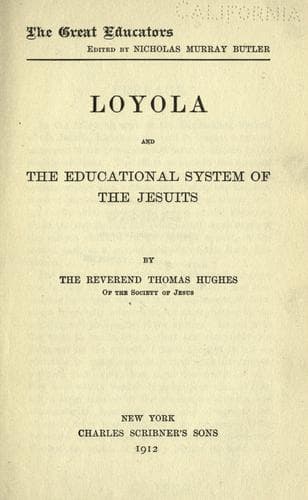
Loyola and the Educational System of the JesuitsHughes, Thomas
History
Loyola and the Educational System of the Jesuits
Hughes, Thomas
Education -- History; Ignatius, of Loyola, Saint, 1491-1556; Jesuits
"In the superior courses, how many questions are there which formerly
never entered into controversy, which now are vehemently assaulted,
and must be established by solid arguments, lest the very foundations
of truth be sapped! Therefore the questions which are alive call for
special discussion, solution, refutation.
"In Physics and Mathematics we must not prove false to the traditions
of the Society, by neglecting these courses which have now mounted
to a rank of the highest honor. If many have abused these sciences
to the detriment of religion, we should be so much the farther from
relinquishing them on that account. Rather, on that account, should
the members of the Order apply themselves with the more ardor to these
pursuits and snatch the weapons from the hands of the foe, and with the
same arms, which they abuse to attack the truth, come forward in its
defence. For truth is always consistent with itself, and in all the
sciences it stands erect, ever one and the same; nor is it possible
that what is true in Physics and Mathematics should contradict truth of
a higher order.
"Finally, in the method of conducting the lower studies, some accessory
branches should have time provided for them, especially the vernacular
tongues and literatures. But the study of Latin and Greek letters must
always remain intact and be the chief object of attention. As they
have always been the principal sources, exhibiting the most perfect
models of literary beauty in precept and style, so are they still. And,
if they were kept more before the eyes and mind, we should not see
issuing from the press, day after day, so many productions of talented
men, with a diction and style no less novel and singular, than are the
thoughts and opinions to which they give expression. The commonalty
regard them with admiring awe and stupor; but men of knowledge and
correct taste look with commiseration and grief on these unmistakable
signs of an eloquence, no less depraved than the morals of the times.
"The adaptation of the _Ratio Studiorum_, therefore, means that we
consult the necessities of the age so far as not in the least to
sacrifice the solid and correct education of youth."[356]
This is the substance of a document not unworthy of the letters and
ordinances in behalf of education, issued by a long line of experienced
and learned judges in the art of training youth. The modifications made
in the old _Ratio_ have been few; and I have taken note of them in the
preceding analysis.
Public-domain text, read in full here on John Shaqi.
Reviews
Reviews
No reviews yet
Be the first to share your thoughts on this work.
Elsewhere in the archive
Join the Discussion
Join the discussion
Sign in to leave a comment or review.
Sign InorCreate an account