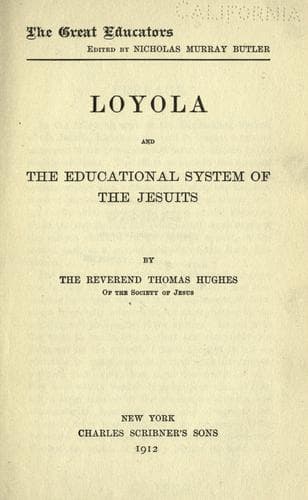
Loyola and the Educational System of the JesuitsHughes, Thomas
History
Loyola and the Educational System of the Jesuits
Hughes, Thomas
Education -- History; Ignatius, of Loyola, Saint, 1491-1556; Jesuits
[98] Essais sur l'Instruction Publique, par Charles Lenormant, membre
de l'Institut; quoted by Rochemonteix, Le Collège Henri IV, tom.
ii, ch. 1, p. 49, in his very instructive discussion on the Jesuit
_internat_, or _pensionnat_.
[99] Monumenta Germaniæ Pædagogica, vol. ii, Pachtler, p. 78.
[100] Const., part iv, ch. 3, decl. B.
[101] Turpissimis signis.
[102] Bibliotheca Selecta, lib. i, ch. 44; Quasnam tetenderit insidias
humani generis hostis, etc.
[103] Ribadeneira, Bollandists, nn. 373 _seq._
[104] Bibliotheca Selecta, lib. i, ch. 40.
[105] Ratio Studiorum of 1599 and 1832, Reg. Prov. 37. The higher
courses are allowed a midsummer vacation of between one and two months;
in the lower or literary course, Rhetoric is allowed one month, the
others classes less. Besides certain feast-days during the year, every
week must have one day free, which, in the higher courses, is the whole
day, but, in the lower, is only the latter part of it.
[106] 1602; Monumenta Germaniæ Pædagogica, vol. ii, Pachtler, p. 467.
[107] Monumenta Germaniæ Pædagogica, vol. ii, Pachtler, p. 411.
[108] Bollandists, n. 374.
[109] Lettre 7 février, 1746; OEuvres, tom. viii, p. 1128; edit. 1817.
[110] Crétineau-Joly, Histoire de la Compagnie de Jésus, tom. iv, ch.
3, p. 209; edit. 1851. This chapter and the following one, ch. 4, in
Crétineau-Joly, pp. 158-297, contain the most varied information on our
subject, regarding professors, writers, scholars, etc.
[111] Epistola de Institutione Juventutis, et Studiis Litterarum
Promovendis, 1639; Mon. Germ. Pæd., vol. ix, Pachtler, p. 62.
[112] Paradise Lost, book iv.
[113] Notice sur le Pensionnat, etc. à Fribourg en Suisse, 1839, pp. 56
_seq._
[114] 1585; Monumenta Germaniæ Pædagogica, vol. ii, Pachtler, p. 411.
[115] Monumenta Germaniæ Pædagogica, vol. ix, Pachtler, p. 59.
[116] Manare, Commentarius.
[117] Crétineau-Joly, tom. i, ch. 3, p. 150.
[118] Compare Cretineau-Joly, tom. i, ch. 6; tom. iv, chs. 3, 4.
[119] The more heavily the strain of war bore upon Germany, the more
assiduously were the succors sent in; no part of the field was more
under Loyola's eye.
[120] History of the Papacy, vol. i, book v, § 3; The First Jesuit
Schools in Germany; Foster's translation, p. 417.
[121] Compare Monumenta Germaniæ Pædagogica, vol. ix, Pachtler, Nr. 72;
Nr. 91; Nr. 92, etc.
[122] This very instructive correspondence may be seen sketched in
Genelli's Life of St. Ignatius of Loyola, part ii, ch. 8, pp. 342
_seq._ 1889.
[123] Ch. 6, above, p. 84.
[124] Const., pars iv, c. 7, decl. E.
[125] Compare Mon. Germ. Pæd., vol. ii, Pachtler, Nr. 38, the
theological faculty of the University of Würzburg, p. 303, n. 7; Mon.
Germ. Pæd., vol. ix, Pachtler, Nr. 67, p. 162, and Nr. 68, p. 178, the
theological and philosophical faculties of the University of Trier, etc.
[126] Compare Monumenta Germaniæ Pædagogica, vol. ii, Pachtler, p. 38,
note about Perugia.
[127] Ibid., p. 51, note about Valencia.
Public-domain text, read in full here on John Shaqi.
Reviews
Reviews
No reviews yet
Be the first to share your thoughts on this work.
Elsewhere in the archive
Join the Discussion
Join the discussion
Sign in to leave a comment or review.
Sign InorCreate an account