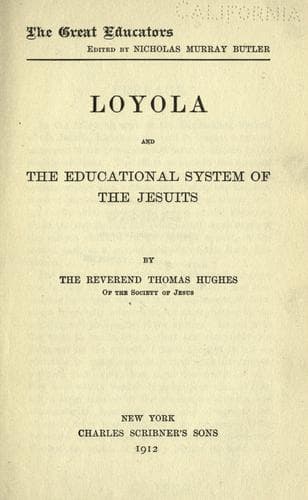
Loyola and the Educational System of the JesuitsHughes, Thomas
History
Loyola and the Educational System of the Jesuits
Hughes, Thomas
Education -- History; Ignatius, of Loyola, Saint, 1491-1556; Jesuits
Civil discords are not the subject of their debates, but the glories
of their native country, its success in arms, all that is congenial
to the young mind and fosters the sentiment of love of country. Among
the students of Rhetoric, forensic debates and judicial trials are
organized; "and when the advocates of both sides have pleaded their
cause in one or two sessions of the court, then," says a document I
am quoting from, dated 1580, "the judge, who has been elected for the
purpose, will pronounce his judgment in an oration of his own; this
will be the brilliant performance; and, to hear it, friends will be
invited, and the Doctors of the University and all the students will be
in attendance."[83] In the programme for the distribution of rewards,
there is described an interesting element, _puer lepidus_, "a bright
young lad," and what he is to do and how he is to bring out the name of
the victor, "whereupon the music will strike up a sweet symphony."[84]
At another time, a set of published theses are defended against all
comers by some philosopher or theologian. And, while games and manly
exercises outside develop physical strength, gentility of demeanor and
elegance of deportment have the stage at their service inside, for the
exhibition of refined manners.
In all this, princes and nobles, future men of letters and of action,
are mingling in daily life, in contest and emulation, with sons of
the simplest burghers. Descartes[85] notes these points sagaciously,
when he recommends to a friend the College of La Flèche: "Young people
are there," he says, "from all parts of France; there is a mingling
of characters; their mutual intercourse effects almost the same good
results as if they were actually travelling; and, in fine, the equality
which the Jesuits establish among all, by treating just in the same
way those who are most illustrious and those who are not so, is an
extremely good invention."[86]
Public-domain text, read in full here on John Shaqi.
Reviews
Reviews
No reviews yet
Be the first to share your thoughts on this work.
Elsewhere in the archive
Join the Discussion
Join the discussion
Sign in to leave a comment or review.
Sign InorCreate an account