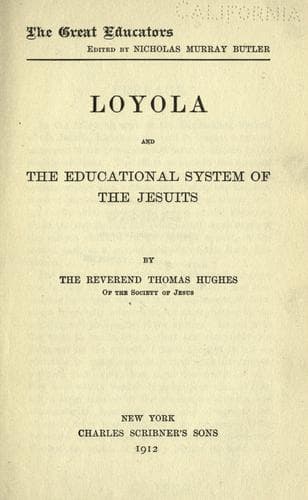
Loyola and the Educational System of the JesuitsHughes, Thomas
History
Loyola and the Educational System of the Jesuits
Hughes, Thomas
Education -- History; Ignatius, of Loyola, Saint, 1491-1556; Jesuits
As the new sciences came into vogue, they received at once the freedom
of this city of intellect; and here they received it first. It has
been said, indeed, that the Society of Jesus, "obstinately bound to
its formalism, refused to admit anything modern, real, and actual,
and that the national languages and literatures, as well as the new
developing sciences, fared ill at its hands." This statement, as far
as it concerns France, is examined by Father Charles Daniel, who to
other valuable works of his own has added the neat little essay called,
_Les Jésuites Instituteurs de la Jeunesse Française, au XVII^e et au
XVIII^e siècle_.[87] As to Germany, we shall see indications enough
on all these subjects in the _Monumenta Germaniæ Pædagogica_. For all
countries there is a sufficiency of information, in the mere text of
the _Ratio Studiorum_, in Jouvancy's classic commentary thereupon, _De
Ratione Discendi et Docendi_, and other authentic documents, besides
the actual practice visible in the colleges. But the whole question
about the vernacular tongues, as if they were kept out of the colleges
by Latin and Greek, is so far an anachronism for the dates and epochs,
regarding which some moderns have agitated the question, that I shall
tell a little anecdote, which will not be so much of a digression, but
that it will place us back just where we are at present.
In 1605, Lord Bacon published his two books on the Advancement of
Learning. The work is considered the first part of his "Novum Organum."
He undertakes to "make a small Globe," as he says, "of the Intellectual
World, as truly and faithfully as he can discover.[88] His subject
is identical, as far as it goes, with the much more extensive and
exhaustive work of Father Anthony Possevino, a famous Jesuit, who had
published, twelve years before, the results of twenty years' travel and
observation, while fulfilling, in many countries, the important duties
of Apostolic Legate, Preacher, Professor. I have two editions of his
great tomes before me. The first is that of Rome, 1593; the other that
of Venice, 1603; this latter is called "the most recent edition."[89]
The only indication which I discern of Bacon's not having profited by
Possevino is this, that he says: "No man hath propounded to himself
the general state of learning to be described and represented from age
to age."[90] Now, as this is saying too much, for it just indicates
what Possevino's labors had been showing to the world during twelve
years, I must conclude that there is no assurance whatever, but that
Bacon profited by Possevino: he seems merely to have gone over the same
ground in English, and done justice to the subject, in his own peculiar
way. Accordingly, he did it what justice he could, in English. Three
years later he writes to Dr. Playfer, Margaret Professor of Divinity
in the University of Cambridge, requesting that the Doctor would be
pleased to translate the work into Latin; and his lordship promises
eternal gratitude.
Public-domain text, read in full here on John Shaqi.
Reviews
Reviews
No reviews yet
Be the first to share your thoughts on this work.
Elsewhere in the archive
Join the Discussion
Join the discussion
Sign in to leave a comment or review.
Sign InorCreate an account