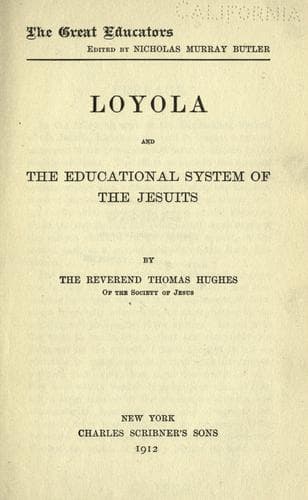
Loyola and the Educational System of the JesuitsHughes, Thomas
History
Loyola and the Educational System of the Jesuits
Hughes, Thomas
Education -- History; Ignatius, of Loyola, Saint, 1491-1556; Jesuits
What reasons does the noble author urge for this
request? Two reasons, of which the first is very noteworthy for our
purpose:--"the privateness of the language, wherein it is written,
excluding so many readers!" And the second is almost as worthy of
note:--"the obscurity of the argument, in many parts of it, excluding
many others!"[91] Here we have our domestic classic author, in the year
1608, endeavoring to get out of his narrow cell, the "privateness of
the English language," into the broad world of the literary public,
where the Jesuit with his tomes was enjoying to the full his literary
franchise. This does not look as if the colleges, at that time, kept
the languages down, but rather that they had in their gift the full
freedom of the literary world, and sent students forth to walk abroad
at their ease there, where Bacon humbly sued for admission!
I was going to quote from Possevino, describing in a graphic way the
daily intellectual life of the great Roman College, with its two
thousand and more students, besides the great body of Professors. But
my limits forbid me to do more than refer to it.[92]
There are two views which may be taken of a coin, and its stamp. One is
taken direct, looking at it in itself; the other is indirect, observing
the impression it leaves in the mould. It leaves a defined vacancy
there. What kind of vacancy was left in the intellectual culture of
Europe, when this intellectual system was suddenly swept away? Before
the Suppression of the Society, some of the institutions, which had
thriven at all, had been inspired by a healthful rivalry. They found,
when the Society was gone, that part of their life decayed. And, while
they themselves began to languish, the place of the Jesuits they could
not fill. Of some others, who lived a life barely discernible, we are
given to understand, that their vitality consisted in the effort to
keep the Jesuits out. I will take an instance from Bayonne.
A work has just been published on the municipal college of Bayonne, by
the Censor of Studies, in the Lyceum of Agen.[93] In seventy pages,
which concern transactions with the Jesuits,[94] the author, in no
friendly tone, narrates the entire history from the documents of the
Jansenist party. I will imitate this example of his so far as to
narrate the following entirely in his own words.
Beginning his last chapter, entitled "Reform and Conclusion," he says
in a tone somewhat subdued, but not more so than his subject:[95] "This
then was the College of Bayonne, which, for a few years more, prolonged
an existence ever more and more precarious; and it was finally closed
in 1792, in spite of several generous efforts at restoring it.
Public-domain text, read in full here on John Shaqi.
Reviews
Reviews
No reviews yet
Be the first to share your thoughts on this work.
Elsewhere in the archive
Join the Discussion
Join the discussion
Sign in to leave a comment or review.
Sign InorCreate an account