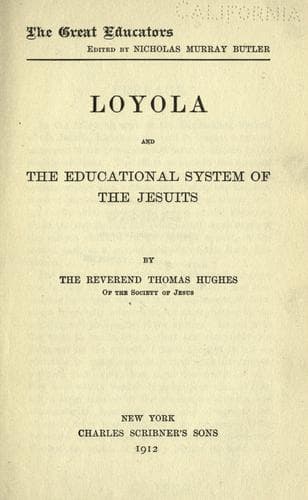
Loyola and the Educational System of the JesuitsHughes, Thomas
History
Loyola and the Educational System of the Jesuits
Hughes, Thomas
Education -- History; Ignatius, of Loyola, Saint, 1491-1556; Jesuits
The first two colleges were established in the same year, 1542,--one
of them in the royal university at Coimbra in Portugal, the other at
Goa in Hindustan. Though they were organized at an early date, only
two years after the foundation of the Order, when as yet no system had
been formally adopted, nevertheless these two first colleges, a good
many thousands of miles apart, were found to have been established in
precisely the same way. Francis Xavier, having been assigned to the
apostolic ministry in the East, began a university there, in which
all the sciences and branches were professed, just as in the European
colleges. This became the base of operations for Japan, China, Persia,
Ethiopia, and the other nations of the East. Forty years later, there
were as many as one hundred and twenty Jesuits in the college.
In 1542, Ignatius had a select body of fifteen or sixteen young men
studying in Paris; others he had placed in Padua or elsewhere. He
availed himself of the actual universities until such time as he should
have his own. War breaking out between the Emperor Charles V and the
French King Francis, all Spaniards and Belgians were ordered out of
France. Such as were Italians remaining in Paris, the other young
Jesuits crossed the frontier to Louvain, under the charge of Father
Jerome Domenech. There the Latin oratory of the youth, Francis Strada,
whom Lefèvre, on his way through Belgium, supplied with matter for his
orations,[116] helped to build up the Order rapidly with two kinds of
men, talented youths, who were captivated by the things they saw and
heard, and men already eminent, who were equally attracted by the scope
of the new Institute. In the young Strada preaching and the eminent
Lefèvre going out of his way to subsidize him with matter, we catch a
family glimpse of that intensified force which can be developed in a
closely bound organization.
Conspicuously wanting in gifts of presence and of learning, Francis
Villanova, sent by Ignatius to the university seat of Alcalà, won
such an ascendency there by his other qualities as a Priest, that a
commodious and flourishing college was soon founded. Father Jerome
Domenech endowed one in his native city of Valentia, 1543. Lefèvre and
Araoz, following awhile by royal request in the suite of the Princess
Mary, daughter of the Portuguese King, and queen of the Spanish King,
founded a college at Valladolid. In Gandia, his own duchy, Francis
Borgia erected and richly equipped a university, which was the first
placed in the hands of the Society.
Public-domain text, read in full here on John Shaqi.
Reviews
Reviews
No reviews yet
Be the first to share your thoughts on this work.
Elsewhere in the archive
Join the Discussion
Join the discussion
Sign in to leave a comment or review.
Sign InorCreate an account