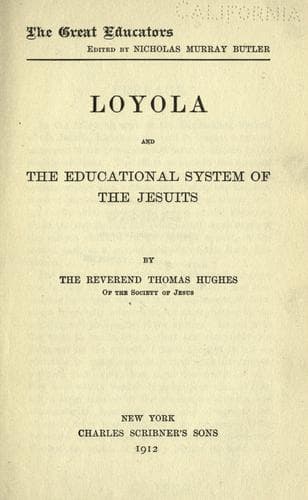
Loyola and the Educational System of the JesuitsHughes, Thomas
History
Loyola and the Educational System of the Jesuits
Hughes, Thomas
Education -- History; Ignatius, of Loyola, Saint, 1491-1556; Jesuits
Colleges at Barcelona, Bologna, Saragossa, arose within the next two
or three years; also at Messina, Palermo, Venice, and Tivoli. It is
evident that Ignatius had a world of administration already on his
hands. As early as March 16, 1540, he had excused himself from granting
an application, because of "much pains he was taking in sending some
to the Indies, others to Ireland and to parts of Italy." Now, though
his forces were increasing, yet he was husbanding them; and even so,
while refusing many applications, he seemed to be everywhere. But this
need not be so much a matter of wonder, if we consider that it is the
right place, and the right move at the proper time, that commands other
places, movements, and times.
At the death of Lefèvre, in 1546, the onward movement of these select
men, coming in contact, either friendly or adverse, with every actual
power in Europe, was so impressive for its strategic completeness, and
so far-reaching in its results, that, as an historian remarks, "These
ten men, so ably chosen, had accomplished to their entire satisfaction,
in less than six years, what the most absolute monarch would not have
ventured to exact of the most blind devotedness."[117]
Hardly had Lefèvre departed this life, when his place was taken by the
last man whom he had dealt with, Francis Borgia, Duke of Gandia, the
friend and cousin of the Emperor Charles V. Still wearing his ducal
robes, until his temporal affairs could be settled, he came to Rome in
1550. He founds the Roman College, which is the centre and type of all
Jesuit colleges.
It was begun on February 18th, 1551, at the foot of the Capitol, with
fourteen members of the Order, and Father John Peltier, a Frenchman,
at their head. Doubling this number in the following September, the
College moved to a larger building. The Professors taught Rhetoric,
and three languages, Hebrew, Greek, and Latin. In 1553, the entire
course of Philosophy and Theology was added. The number of Jesuit
students among the auditory amounted, in this year, to sixty, and,
in the following year, to one hundred. A few years later, Vittoria
Toffia, niece of Paul IV, and wife of Camillo Orsini, provided the
institution with a splendid property. Thenceforth, the number of Jesuit
students alone was as high as 220, brought together from sixteen or
more different nations, most of them familiar with many languages, all
speaking by rule the tongue of the country in which they were residing,
and all competent to speak and teach in the one universal and learned
language of the time, the Latin tongue.
Public-domain text, read in full here on John Shaqi.
Reviews
Reviews
No reviews yet
Be the first to share your thoughts on this work.
Elsewhere in the archive
Join the Discussion
Join the discussion
Sign in to leave a comment or review.
Sign InorCreate an account