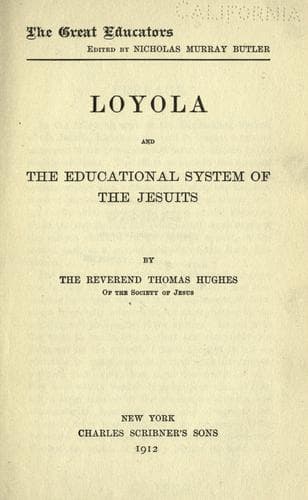
Loyola and the Educational System of the JesuitsHughes, Thomas
History
Loyola and the Educational System of the Jesuits
Hughes, Thomas
Education -- History; Ignatius, of Loyola, Saint, 1491-1556; Jesuits
The reason for this reserve is not hard to discern. In an organization
like his, there are no men at large to lend. And, were the most
eminent men assigned for work outside of the Jesuit colleges and
universities, the younger generation of the Order would practically
be debarred from the influence of their type of eminence. And again,
if there were eminent men laboring in a country, without the stable
abode of a Jesuit college in the same place, there would be no
propagating the distinctive work of the Order itself, by means of
the men of that country. Yet, as he projected a native clergy for
Germany, so he intended native Jesuits for the Germans. Besides, it
does not seem possible to accept of a chair outside, except on the
basis of some pecuniary consideration for the individual Professor.
Now this is a situation which he does not accept. A Professed Father
is not to sacrifice his religious life and independence, bound to
a work outside of the Order's own houses, and that for a valuable
consideration. Ignatius accepts of no obligations to fill chairs, save
as accepting universities, which contain those chairs.[124] And, as
to pecuniary considerations, his principle is, _Gratis accepistis,
gratis date_; "Give freely what you have freely received." To this
cardinal principle the statutes of so many universities, if not of all,
in which a Jesuit College conducted any of the faculties, distinctly
refer, as the ground for exempting Religious of the Society from all
pecuniary charges, incidental to university affairs.[125] No ingenious
compromise was admitted which tended to relax this principle, regarding
a pecuniary consideration.[126] On the contrary, the most legitimate
and ample revenues offered were not accepted as a recommendation for a
university, if there were any conditions whatever not in keeping with
the Institute.[127]
The German College in Rome was founded by Ignatius, to form German
ecclesiastics for the Germans. At that time benefices and parochial
cures, in the German Emperor's dominions, were generally vacant for
want of Priests. It soon came to pass that Priests were found to be in
waiting, for want of benefices. It was not merely for the ordinary cure
of souls that this college received so much attention from Loyola. True
to himself, ever contemplating something eminent,--_rarum et eximium
facinus_, as he said once to the Scholastics of Coimbra, "that rare
and excellent achievement; which is worth more than six hundred common
ones,"--he was founding a seminary for preachers, professors, prelates.
If the students sent from Germany, to be admitted and supported on
this foundation, are not noblemen, "at all events," writes Ignatius in
1552, "let nobility of soul not be wanting to them."[128] This is the
institution which caused so much vexation to non-Catholic Germany. It
renovated the priesthood.
Public-domain text, read in full here on John Shaqi.
Reviews
Reviews
No reviews yet
Be the first to share your thoughts on this work.
Elsewhere in the archive
Join the Discussion
Join the discussion
Sign in to leave a comment or review.
Sign InorCreate an account