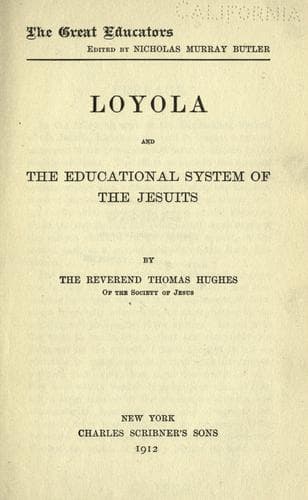
Loyola and the Educational System of the JesuitsHughes, Thomas
History
Loyola and the Educational System of the Jesuits
Hughes, Thomas
Education -- History; Ignatius, of Loyola, Saint, 1491-1556; Jesuits
Thus, then, in a short official career of sixteen years, Ignatius
had the gratification of seeing a new and vast educational policy
crowned with success. In spite of the active opposition which powerful
interests in Rome led against him--and a vigorous siege from the side
of the schoolmasters was not to be despised, nor should it fail to be
recorded,--in spite of the desperate hostility of the Sorbonne, which
was but beginning its war upon the Society in France, with storms at
Toledo and Saragossa flanking his movements in Spain; in spite of the
open war with heresy in Protestant Germany, where acrimony, distilled
to its last degree of concentration, was to embitter history, till the
days of Ranke and Janssen should come, and begin to vindicate the truth
of history; thanks to the labors of Ignatius, the monopoly of education
was being broken down; the old universities were no longer either the
sole depositories of superior instruction, or the arbiters of the
intellectual life of Europe; and all the best learning, which the most
accomplished men could impart, was now being given gratuitously, and
in as many centres of educational activity as the Society was allowed
to create. And, whereas it is put down to the credit of Germany, that
sixteen of the old universities had arisen on its soil, now, in the
German Assistency of the Society, there arose more than sixteen Jesuit
universities, besides two hundred colleges. And, in virtue of Papal
charters, it was already an accomplished fact, that all the powers
of universities, with regard to the degrees of Bachelor, Master,
Licentiate, and Doctor, were vested in the head of the Order, who could
delegate the same to subordinate Superiors.[129]
No wonder all the faculties of Christendom considered the Order an
intruder and an aggressor. It might be considered so to-day. Free and
universal education was at the doors of all. We, men of the nineteenth
century, may flatter ourselves that it was the spirit of our age which
breathed upon the Order of Jesus, three centuries before the time.
Perhaps so. But we shall have to wait a few centuries more, even
beyond the nineteenth century, before we come to such education given
universally and given gratuitously. For it is one of the most palpable
characteristics of all educational and other philanthropy which we know
of, that it is an extremely expensive thing.
Public-domain text, read in full here on John Shaqi.
Reviews
Reviews
No reviews yet
Be the first to share your thoughts on this work.
Elsewhere in the archive
Join the Discussion
Join the discussion
Sign in to leave a comment or review.
Sign InorCreate an account