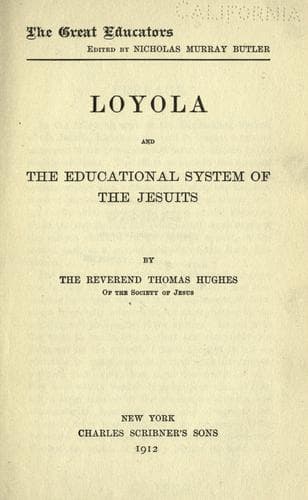
Loyola and the Educational System of the JesuitsHughes, Thomas
History
Loyola and the Educational System of the Jesuits
Hughes, Thomas
Education -- History; Ignatius, of Loyola, Saint, 1491-1556; Jesuits
All the time since then he had spent in extreme poverty, in the
practice of austerity, in the laborious travels of a pilgrim, in the
more laborious pursuit of letters, under the stress of persecution,
prisons, and chains, and under the relentless fatigue of a universal
foresight, vigilance, and administration. He had proved himself a
leader and commander of men, as nature had made him to be, and as
history shows that he was.
In an especial manner, he is famous for his prudence. Approaching
every enterprise with the most varied and exhaustive deliberation,
spending forty days of meditation on determining a single point of
the Constitution, throwing upon his premises every kind of light
from consultation and advice, and having habitually in his room, for
reference, only two books, the New Testament, and the Imitation of
Christ, he thought out every plan to the last degree of definiteness
and consistency. Having once reached such a definite conclusion, he
was not easy to move thenceforth out of the direction taken. Quite
otherwise. With the utmost vigilance, he applied himself and he
applied all the means, whether they were persons available or measures
necessary, to the execution of his purpose. Even when, as often seemed
to be the case, he was starting from principles other than those of
ordinary human foresight, apparently from a pure trust in Divine
Providence, he did not exempt himself from applying, with the same
circumspection and diligence as ever, the means adequate to execute
what he had begun. Waiting fourteen hours, and fasting withal, in the
ante-chamber of a prince, lest the propitious occasion should slip,
writing out the same letter twice, thrice, and oftener, lest the right
thing should not be said in the right way, and sending out thirty
letters in one night, he exhibited, in the administration of great
things and small, what had marked all his previous deliberation, the
highest degree of consummate prudence and of practical perfection.
If, in all this, there are many eminent qualities to admire, there is a
resultant fact more marvellous still. He did his work so that it went
on without him. And hence, if, whenever he happened to be anywhere on
the field of action, account had to be taken of such a man, it will
not perhaps appear singular that his Order too, even when ostracized
and expatriated, is taken into account, if it is anywhere visible on
the social horizon. While I am writing this, three hundred and fifty
years after his time, the Bundesrath, on closing the Kulturkampf, and
admitting all the exiled Orders of the Catholic Church back into the
Empire of Germany, makes an exception of the Jesuits. It bans the Order
of Jesus, and gives no reason, beyond the palpable fact that the Order
is what it is. Evidently, Ignatius of Loyola did his work so as to make
it go on without him; and go on just as he made it.
CHAPTER IX.
SUBSEQUENT ADMINISTRATIONS.
Public-domain text, read in full here on John Shaqi.
Reviews
Reviews
No reviews yet
Be the first to share your thoughts on this work.
Elsewhere in the archive
Join the Discussion
Join the discussion
Sign in to leave a comment or review.
Sign InorCreate an account