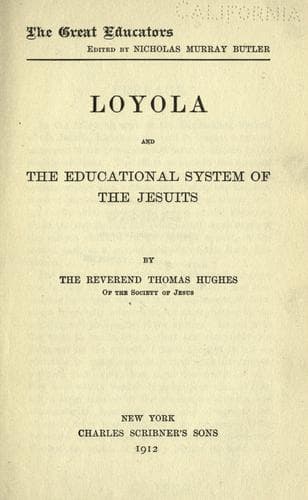
Loyola and the Educational System of the JesuitsHughes, Thomas
History
Loyola and the Educational System of the Jesuits
Hughes, Thomas
Education -- History; Ignatius, of Loyola, Saint, 1491-1556; Jesuits
Let us now close our sketch of the great educator, Saint Ignatius
of Loyola. All the particulars of his death have been preserved for
us by those who were with him at the last. They were not his first
companions. Of these, the few who survived at the present date,
sixteen years after the foundation of the Society, were scattered in
various climes. The members with him were John Polanco, his polished
secretary, André Frusis, a Frenchman, one of the most gifted of
linguists and of _littérateurs_, Christopher Madrizi, a university
Doctor of Alcalà, and Jerome Nadal, whom in Paris, long before,
Ignatius had endeavored to enlist in the service of his Institute;
but Nadal had rejected all overtures, pointing to the Bible under his
arm, and saying he wanted no other institute save that. He was a man
of the first quality in judgment and the governing cast of mind. Later
on, when the exploits of Saint Francis Xavier in India and Japan had
become the talk and admiration of Europe, Nadal entered the Order, so
cautiously that one might say he did it reluctantly; yet he did it. His
subsequent career showed that he had made a mistake, when he missed a
place in the very first ranks.
Others were close by. Laynez lay in a sick-room; as was thought, on his
death-bed; Mendoza too, and Martin Olave. The latter, some thirty years
before, was a boy whom Ignatius met, when as a poor pilgrim he reached
Alcalà from Barcelona, to take up his university studies. The boy gave
him an alms, the first received by Ignatius in that city. Time had
passed since then. The boy had become a Master of Arts, and, in 1543, a
Doctor of the Paris University, remarkable in many ways for virtue and
learning. Now, a man of mature age and great authority, he had embraced
the Institute of Ignatius. He alone of the invalids died immediately
after his master in religion.
The latter, on July the 30th, told them he was about to die. But,
diseases having preyed upon him for years, the physicians did not
confirm what he said; and Father Ignatius made no more statements on
the subject. He spent the evening in his usual manner, transacted some
business with perfect serenity of mind, and then was left alone till
the morrow.
The morrow is just dawning, when they find him breathing his last. He
declines to accept any potion. Joining his hands together, with his
eyes fixed heavenward, and pronouncing the name of "Jesus," the founder
of the Society of Jesus passes away from this life, in the Professed
House at Rome.
It was the thirty-first day of July, 1556. He was sixty-five years of
age. Thirty-five years had passed, since the Knight of the King of
Navarre had, with such solemnity, changed his garb, hung up his sword
and poniard in the sanctuary of Montserrat, and vowed himself to be a
Knight in the Kingdom of Christ.
Public-domain text, read in full here on John Shaqi.
Reviews
Reviews
No reviews yet
Be the first to share your thoughts on this work.
Elsewhere in the archive
Join the Discussion
Join the discussion
Sign in to leave a comment or review.
Sign InorCreate an account