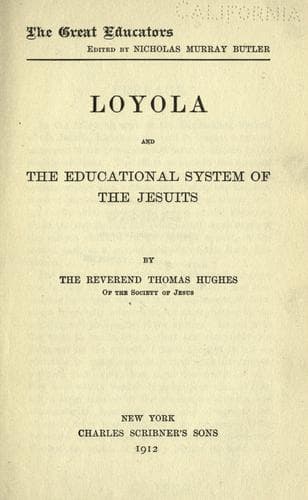
Loyola and the Educational System of the JesuitsHughes, Thomas
History
Loyola and the Educational System of the Jesuits
Hughes, Thomas
Education -- History; Ignatius, of Loyola, Saint, 1491-1556; Jesuits
In 1573 Father Everard Mercurian, a Belgian, was elected to succeed
Saint Francis Borgia. He was sixty-eight years old at the time of his
election, and lived eight years after. He drew out of the Constitution
various summaries of rules for the guidance of the chief officers in
the Society. Those which concern studies are given in a few pages of
the Monumenta.[133]
At his death, a young man thirty-seven years old, who had entered the
Order only about twelve years before, was elected to succeed him. This
was Claudius Aquaviva, son of Prince John Aquaviva, Duke of Atri. He
was a man who, for his superior executive abilities and his services
rendered to the Order in times most critical, has been regarded as
a second founder. As to what his administration saw effected in the
matter of education, the _Ratio Studiorum_ bears witness. He governed
the Society during thirty-four years.
Mutius Vitelleschi, one of the mildest and gentlest of men, but not on
that account ineffective in his government, succeeded Aquaviva, filling
a term of thirty-one years, from 1615 to 1646. Various pedagogic
interests occupied the attention of the general assembly, by which
he was elected; in particular, the promotion of Humane Letters, the
means of supplying Professors, and the searching character of the
examinations ordained, at every step in their studies, for the members
of the Society.
The farther the Society advanced in history, the less there was of new
legislation. The tension grew on the side of administration; and the
urgency shown by general assemblies evinces this. The philological
seminary was developed for the junior scholastics; and a classic form
drawn up for it by Jouvancy. As distinguished talents for preaching
and governing were treated with the special favor of being allowed to
compensate for some deficiencies, in the qualifications requisite for
the degree of Profession in the Order, so special legislation provided
for similar eminence in literature, in Oriental languages, in Greek and
Hebrew.
Mathematics had, from the first, been a department of activity native
to the energies of the Company. The schools of Geography and History
developed in the seventeenth and at the beginning of the eighteenth
centuries. The school of modern Physics then asserting itself, and
running so close upon the field of Metaphysics, was subjected to
regulations in the assemblies of 1730 and 1751.
Public-domain text, read in full here on John Shaqi.
Reviews
Reviews
No reviews yet
Be the first to share your thoughts on this work.
Elsewhere in the archive
Join the Discussion
Join the discussion
Sign in to leave a comment or review.
Sign InorCreate an account