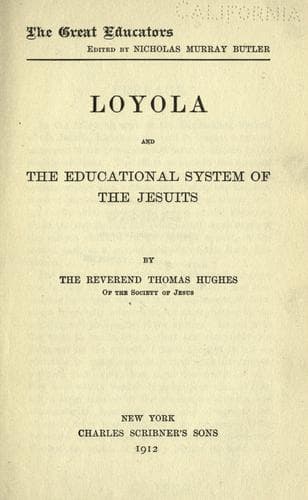
Loyola and the Educational System of the JesuitsHughes, Thomas
History
Loyola and the Educational System of the Jesuits
Hughes, Thomas
Education -- History; Ignatius, of Loyola, Saint, 1491-1556; Jesuits
After the restoration of the Order, social and educational
circumstances being so immensely altered, the whole ground had to be
surveyed again, with a view to adaptation; the curriculum had to be
expanded, and, where necessary, prolonged to meet the growing demands
of the exact sciences; and an indefinite number of specialties to
be provided for, by the selection and fostering of special talents.
These special lines are, in the terms of the latest general assembly,
"Ancient Languages, Philology, Ethnology, Archæology, History, Higher
Mathematics, and all the Natural Sciences." We are thus brought down,
in the history of general legislation, to the very recent date, 1883,
less than ten years ago.
Meanwhile the Generals, on whom rested the burden of supervising all
this, discharged the functions of administration. Father Vincent
Caraffa promoted and urged on the pursuit of Belles Lettres, and
defined positions in Mathematics. Father Francis Piccolomini, in a
general ordinance for all the higher studies, defined the stand to
be taken by Professors, as representing the Society itself in their
chairs; so, too, Father Goswin Nickel, with reference to certain new
issues. Both he and his successor, Paul Oliva, had to face the new
contingencies which arose from the charges of the Jansenists against
what they called the loose moral teachings of the Jesuits. Father
Oliva stimulated the pursuit of excellence in Humane Letters, in the
Greek, Hebrew, Arabic, and Chaldaic languages. Positions of Descartes,
Leibnitz, as well as of certain others in Philosophy and Theology,
were animadverted upon by the Generals Tamburini and Retz. Father
Ignatius Visconti urged again the pursuit of perfection in literary
matters, and in the manner of conducting the schools of literature.
And the General Aloysius Centurione, shortly before the Suppression,
laid down the clearest principles with respect to the study of Moral
Theology, and the examinations therein. Since the restoration of the
Order, Fathers Roothaan, Beckx, and the actual General, Anthony M.
Anderledy, have devoted their own attention and directed that of the
Society to the ways of accepting, with undiminished energy, the altered
and unfavorable situation, in which the present century has placed the
Order, and hampers the revived Institute.
Public-domain text, read in full here on John Shaqi.
Reviews
Reviews
No reviews yet
Be the first to share your thoughts on this work.
Elsewhere in the archive
Join the Discussion
Join the discussion
Sign in to leave a comment or review.
Sign InorCreate an account