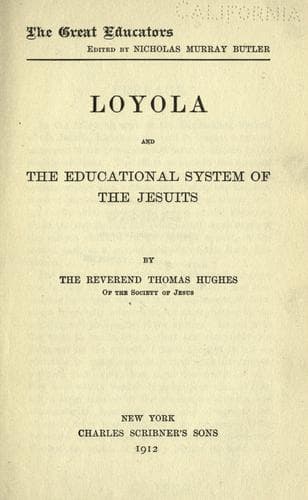
Loyola and the Educational System of the JesuitsHughes, Thomas
History
Loyola and the Educational System of the Jesuits
Hughes, Thomas
Education -- History; Ignatius, of Loyola, Saint, 1491-1556; Jesuits
In the methodical or synoptic table, at the end of the De Backers'
work, not only are the subjects well-nigh innumerable, which have their
catalogues of authors' names attached to them, but such subjects too
are here as might not be expected. Thus "Military Art" has 32 authors'
names under it; "Agriculture" 11; "Navy" 12; "Music" 45; "Medicine" 28.
To conclude then our History of this Educational Order, we have one
synoptical view of it in these twelve or thirteen thousand authors,
all of one family. We have much more. This one work "attesting," as
De Backer says in his preface, "at one and the same time a prodigious
activity and often an indisputable merit," whereof three and a half
centuries have been the course in time, and the whole world the place
and theatre, is a general record of religion, letters, science, and
education, in every country, civilized or barbarous, where the Society
of Jesus labored and travelled. And where has it not done so? In many
parts of the world it was the first to occupy the field with literary
men, who then sent communications to their superiors, or to learned
societies, about the manners of different countries, the state of
religion there, of letters, science, and education, including reports
of their own observations in geography, meteorology, botany, astronomy,
mineralogy, etc. Original sources, from which later history in North,
South, and Central America is drawing materials, are seen described
here as they appeared; so too with regard to Japan, China, Thibet, the
Philippine Islands, Hindustan, Syria, as also to-day with respect to
the native tongues of the North American Indians. Here the record of
published literature, described and catalogued according to date, marks
the stages of mathematical and physical science, from the end of the
sixteenth century onwards, and of magnetic and electrical researches
all through last century; as well as the relationship between the books
of Jesuit authors and similar or kindred ones, by persons outside the
Society, in different countries and of divers religions.
In short, works composed in most of the tongues of the world exhibit
the chief periods in universal culture, and the developments elaborated
in the civilization of mankind.[143]
PART II.
ANALYSIS OF THE SYSTEM OF STUDIES
CHAPTER X.
AQUAVIVA. THE RATIO STUDIORUM.
So centralized an Order as the Society of Jesus, which formed its
Professors for every country, and sent them from one place to another,
undertook, in doing so, to exhibit a definite system of education, of
courses, of method. Besides such a unity of method, it professed also a
consistent uniformity of doctrine.
Public-domain text, read in full here on John Shaqi.
Reviews
Reviews
No reviews yet
Be the first to share your thoughts on this work.
Elsewhere in the archive
Join the Discussion
Join the discussion
Sign in to leave a comment or review.
Sign InorCreate an account