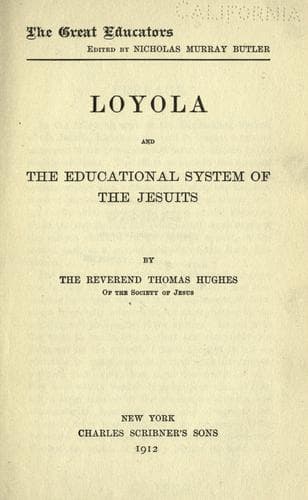
Loyola and the Educational System of the JesuitsHughes, Thomas
History
Loyola and the Educational System of the Jesuits
Hughes, Thomas
Education -- History; Ignatius, of Loyola, Saint, 1491-1556; Jesuits
Before its time there was no one method which could be considered
universal; because there was no teaching body itself universal. The
Order, as it branched out into the world, found a variety of systems
in vogue; and the Jesuit Professors conformed, as best they could, to
the local traditions of populations very diverse, in universities which
were distinct and mutually independent. But, while they endeavored
to better such systems, in accordance with the plan of their own
Constitution, it was clear that they fell short of realizing the idea
of their founder. Hence variations and dispensations were part of the
usual order of the day.
Yet there is a best way of doing everything; and, not least, in
education. In such a best way, some elements are essential at all
times, while others are accidental, and vary with time, place, and
circumstance. The ideal system will preserve in its integrity all
that is essential, and then will adapt the general principles with the
closest adjustment to the particular environment.
Besides the unity of method desired, which I may define to be _the best
way best adjusted to circumstance_, there was need, as I have just
said, of a consistent uniformity of doctrine; lest, in the same chair
of philosophy, of divinity, or of science, or in chairs placed side
by side, one Professor should say Yea to a question, and another Nay
to the same question, with no more material a reason evident for the
difference, save that one taught here and the other there, one spoke
yesterday, the other speaks to-day. The educational effects, however,
are far from being immaterial; for, contradictory statements eliding
one another, it is quite possible that the students understand less the
next day than the day before. And, as to the Professors themselves,
nothing can imperil more the harmony and efficiency of an educational
organization, than disagreement of opinion in the function and act of
teaching. In philosophy, the occasions for dispute spring off at every
turn. Theology, as every one knows, is made to bristle with them. And,
among men who are themselves educated to the highest degree of mental
culture, interests and questions like these are far more absorbing than
money, place, or power elsewhere. If anywhere ideas rule, it is among
men of profound thought; as the intense intellectuality of the mediæval
universities had shown, with all the consequences of unlimited vagaries
in an unbridled scholasticism; or, again, as the whole history of the
intellectual Greek world had evidenced, whether in the early ages of
the Christian Church, or in the heathen generations before.
Public-domain text, read in full here on John Shaqi.
Reviews
Reviews
No reviews yet
Be the first to share your thoughts on this work.
Elsewhere in the archive
Join the Discussion
Join the discussion
Sign in to leave a comment or review.
Sign InorCreate an account