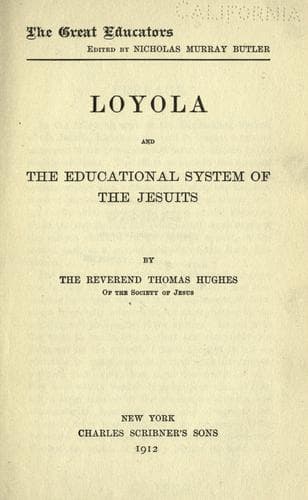
Loyola and the Educational System of the JesuitsHughes, Thomas
History
Loyola and the Educational System of the Jesuits
Hughes, Thomas
Education -- History; Ignatius, of Loyola, Saint, 1491-1556; Jesuits
He calls their attention to an important point, in what is now styled
Pedagogics, or the Science of Education. It is, that, in the form now
sent out, the Fathers had taken pains to explain their reasons for
arriving at conclusions. That would not be done in the System to be
drawn up later, which would contain only the statement of directions
for all to follow. In these words, we have a most important distinction
laid down between the science which underlies the system of education,
and the practical method itself which rests upon the science. The
_Ratio Studiorum_, as subsequently promulgated, is a practical method.
The science is sketched, as need arises, in the preliminary _Ratio_ of
1586.
At the same time, Father Aquaviva despatched another letter, about
which he says, in a postscript to the foregoing, that the six points
provisionally laid down in it are to be subjected to the same
examination as the preliminary _Ratio_ itself.
In this supplementary epistle, he premises that it will require much
time and consideration to issue the final code of rules; and therefore,
as a direction for the time being, he issues the following:--
First, Professors shall adhere to St. Thomas Aquinas as their standard
in theology.
Secondly, they shall take care, in their manner of teaching, always to
consolidate faith and piety.
Thirdly, he lays down a principle of still wider application, and one
which seems vital in the whole theory and practice of teaching: "Let
no one defend any opinion which is judged by the generality of learned
men to go against the received tenets of philosophers and theologians,
or the common consent of theological schools." This touches a vital
element in education. If we suppose that the teacher's art lies, not in
giving forth the lucubrations of his own private thoughts and theories,
but in imparting solid results, approved and ascertained, to those who
come for such results, and wish to receive them in the most approved
way, then the Professor in his chair ought not to mistake himself for
the author in his study, nor should he practise on living men, whose
life is all before them, what he might, with more propriety, first
practise on the leisured world, and test elsewhere, either in the
printed page, or in conference with his equals. The Professor, as such,
is not the original investigator. In mathematics, he is notoriously
not so. In that branch, the best teacher is the man who walks along a
definite line, turns neither to the right nor left, and finishes in
a definite time; or else his scholars will never finish. To a certain
degree, the same holds in all courses. If a man is theorizing, when
he ought to be instructing, he goes off the line of perfect system,
however much pains he takes with his matter; just as much as if, taking
no pains whatever, he neglected his matter altogether, went behind it,
or around it, gave histories of his branch, methods of teaching it, and
Public-domain text, read in full here on John Shaqi.
Reviews
Reviews
No reviews yet
Be the first to share your thoughts on this work.
Elsewhere in the archive
Join the Discussion
Join the discussion
Sign in to leave a comment or review.
Sign InorCreate an account