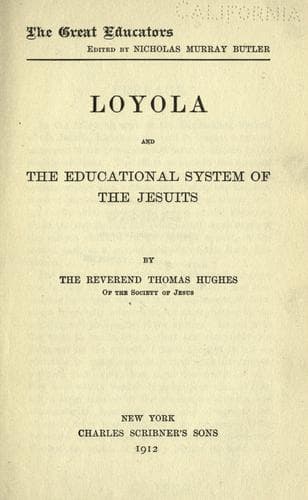
Loyola and the Educational System of the JesuitsHughes, Thomas
History
Loyola and the Educational System of the Jesuits
Hughes, Thomas
Education -- History; Ignatius, of Loyola, Saint, 1491-1556; Jesuits
The Sacred Scriptures. The Length of the Course in Divinity. The Means
of finishing that Course in Four Years. The Method of Lecturing. The
Questions which are either not to be treated by the Theological
Professors, or are to be treated only at a Certain Part of the Course.
Repetitions. Disputations. The Choice, Censorship, and Correcting of
Opinions. The Private Studies of Students. Vacations. The Degrees of
Bachelor, Master, Doctor. Controversial Theology. Moral Theology.
Hebrew. The Study of Philosophy, which includes Physics. Mathematics.
Literature, that is, Grammar, History, Poetry, Rhetoric. Seminaries
for Literature and the Higher Faculties. The Professors of Literature.
The Grammar to be used. Greek. Different Exercises in the Classics.
Incitements to Study. The Method of Promotion. Books. Vacations in the
Lower Classes. Order and Piety. The Respective Objects and Exercises of
the Classes of Grammar and Humanity. The Class of Humanity. The Class
of Rhetoric. General Distribution of Time during the Year.
These are the matters handled in the publication of 1586. In the course
of treatment, this document contains, by way of a running commentary,
the complete theory of Education, or Science of Pedagogics, as
understood by these critics. It will not be possible, within the brief
limits of this work, to give more than a bare sketch of the pedagogical
elements contained in the one hundred and fifty pages of the _Monumenta
Germaniæ Pædagogica_.[150]
A second, partial edition of this preliminary _Ratio_ was sent out by
Father Aquaviva, in 1591, to which an entertaining bibliographical
history is attached.[151] In 1593, the fifth general assembly of
the Order met, Claudius Aquaviva presiding. By this time, during the
interval of seven years which had elapsed since the first edition,
the book had been subjected to examination in all the Provinces;
observations and criticisms had been returned; it had been re-committed
to the Fathers at Rome, and revised by the General with his Assistants;
and had again been sent out for trial. The Provincials and Deputies,
meeting in 1593, brought with them the reports of how the system
worked. Its slightest defects were noted.[152] Most asked for an
abridged form.
Amid the very grave questions then pending, the assembly took some
action on the _Ratio_. It was re-committed once more to the competent
authorities for revision. And it assumed its last and definite form,
in what was probably its ninth edition. This last issue, in the year
1599, after fifteen years spent on the elaboration of it, is the RATIO
STUDIORUM.
Public-domain text, read in full here on John Shaqi.
Reviews
Reviews
No reviews yet
Be the first to share your thoughts on this work.
Elsewhere in the archive
Join the Discussion
Join the discussion
Sign in to leave a comment or review.
Sign InorCreate an account