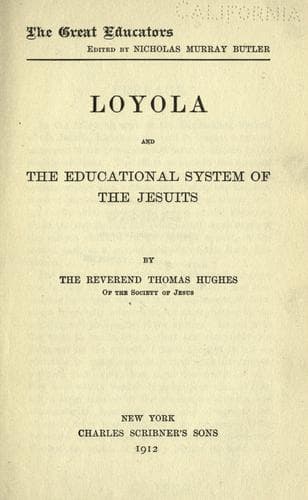
Loyola and the Educational System of the JesuitsHughes, Thomas
History
Loyola and the Educational System of the Jesuits
Hughes, Thomas
Education -- History; Ignatius, of Loyola, Saint, 1491-1556; Jesuits
The six Fathers, who drew it up, state, in their introduction, that
there are two mainstays and supports of the Society of Jesus, "an
ardent pursuit of piety and an eminent degree of learning," _ardens
pietatis studium et præstans rerum scientia_. If piety is not illumined
with the light of learning, it can be, no doubt, of great use to the
person who possesses it, but of scarcely any use in the service of the
Church and of one's neighbor, in the administration of the Word and of
the Sacraments, in the education of youth, in controversies with those
who are hostile to the faith, in giving counsel, answering doubts, and
in all other offices and functions, which are proper to men of the
Order. All these call for an endowment of learning not common, but
excelling in its degree.
To acquire such learning, it is of supreme consequence that we set
before ourselves what path we enter on, what arts we employ, and what
means we use; because, unless a ready and tried method be adopted,
_ratio facilis ac solers_, much labor is spent in gathering but
little fruit; whereas, if the labor of studies be guided by some sage
rule, great results are compendiously obtained, at the cost of little
research.
Then the Commission goes on to say: "We have undertaken to teach,
not only members of the Order, but youth from the world outside. The
number of this latter class is vast; it includes brilliant talent, and
represents the nobility. We cannot imagine that we do justice to our
functions, or come up to the expectations formed of us, if we do not
feed this multitude of youths, in the same way as nurses do, with
food dressed in the best way, for fear they grow up in our schools,
without growing much in learning. An additional spur is felt in the
circumstance, that whatever concerns us is public and, day after day,
is before the eyes of all, even of those who are not well disposed
towards us." The Fathers consider it unnecessary to enlarge upon that
harmony of views, so much commended in the Constitution, as to matters
of public policy or teaching; they say, "sufficient regard could not,
up to this, be paid to such harmony; for, when no common order or
form was as yet prescribed, every one thought that he could hold what
sentiments he liked, and teach them to others in the manner he himself
preferred; so that sometimes the members of the Order disagreed as much
among themselves, as with others outside."[147]
After describing, in vivid terms, the manner in which they had
conducted their deliberations, and arrived at conclusions, and how,
when any keen dispute had arisen among them,[148] they had divided and
distinguished the disputed matter, and had examined it during two and
even three days, till they came to settle at last on what all of them
accepted, the critics come to the Practice and Order of Studies;[149]
and upon this they enlarge, in successive chapters, under the following
heads:--
Public-domain text, read in full here on John Shaqi.
Reviews
Reviews
No reviews yet
Be the first to share your thoughts on this work.
Elsewhere in the archive
Join the Discussion
Join the discussion
Sign in to leave a comment or review.
Sign InorCreate an account