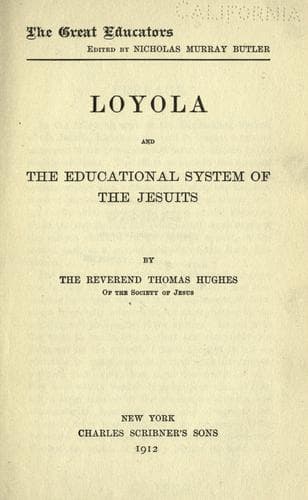
Loyola and the Educational System of the JesuitsHughes, Thomas
History
Loyola and the Educational System of the Jesuits
Hughes, Thomas
Education -- History; Ignatius, of Loyola, Saint, 1491-1556; Jesuits
Geography is not to be separated from History. Up to the end of the
sixteenth century, Ptolemy's Geography, corrected, modified, altered,
according to the reports of navigators, had been the scientific
standard, but uncertain, vacillating, and self-contradictory. From the
earlier part of the seventeenth century, the astronomical observations,
sent from the far East by the Jesuit missionaries, emphasized the need
of a general reform, already sufficiently evident. Father Riccioli,
assisted by Father Grimaldi, who is known in science as one of the
precursors of Newton, undertook, in his _Geographia Reformata_, the
reform of Geography by means of Astronomy.[171] For this purpose, he
created first his own metrology, identifying, and reducing to a common
denomination, all the measures received in reports from different parts
of the earth. The first eclipse of the moon which he makes mention
of, among his astronomical reports, had been observed on the night
of November 8, 1612, by Father Scheiner at Ingolstadt and by Father
Charles Spinola at Nangasaki in Japan. At the time that Riccioli
was writing, the Jesuit missionaries had multiplied in China. Adam
Schall died in 1666, holding the post of President of the Mathematical
Tribunal at Pekin; he was followed by Ferdinand Verbiest; and then a
long line of imperial astronomers of the Celestial Empire, Koegler,
Hallerstein, Seixas, Francesco, De Rocha, Espinha, continued to send
their reports, either to the colleges of their respective Provinces, or
to other mathematical centres, or to the learned societies in Europe,
whereof not a few Jesuits were members. Meanwhile, scientific returns
from Hindustan, Siam, Thibet, on one side of the globe, and from San
Domingo on the other side, poured into the Collège Louis-le-Grand,
and made of this educational centre an indispensable auxiliary to the
Bureau of Longitudes. All this, reacting on education, was received
with satisfaction by the general world, and drew the pedagogic bodies
steadily, though with some difficulty, on the line of progress. The
University of Paris was quite tardy in following up the steps of the
Jesuits.[172]
Public-domain text, read in full here on John Shaqi.
Reviews
Reviews
No reviews yet
Be the first to share your thoughts on this work.
Elsewhere in the archive
Join the Discussion
Join the discussion
Sign in to leave a comment or review.
Sign InorCreate an account