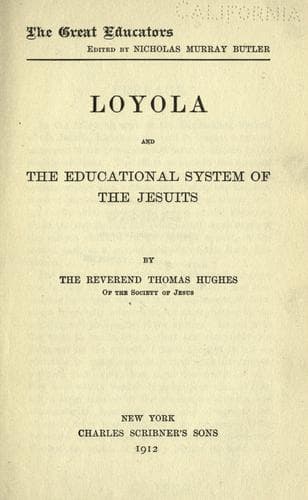
Loyola and the Educational System of the JesuitsHughes, Thomas
History
Loyola and the Educational System of the Jesuits
Hughes, Thomas
Education -- History; Ignatius, of Loyola, Saint, 1491-1556; Jesuits
As to Mathematics in education, it is evident that a similar process
of development must have been the history of this branch, with the
limitation however, that mathematical science has not been so nearly
created anew within these last centuries, as some other departments.
Father Christopher Clavius, "the Euclid of his time," was engaged by
Gregory XIII in reforming the Calendar, the same which we use to-day;
he died in 1612. His death intervening, while his complete works were
being republished, Father Ziegler superintended the new edition, till
it was finished in five tomes. Francis Coster, at Cologne, Hurtado
Perez, at Ingolstadt, Henry Garnet, an Englishman, and Grienberger,
successor of Clavius, both at Rome, belonged, with other mathematicans
of the Order, to the sixteenth century. The writers of the preliminary
_Ratio_, 1586, require that, in a brief course of Mathematics,
"Euclid's Elements" "be seasoned always with some application to
Geography or the Sphere"; then, in the following year, the rest of
Father Clavius' "Epitome of Practical Arithmetic"[173] is to be
finished;[174] and special courses are provided for members of the
Order, who give promise of eminence.[175]
Indeed, whether as Professors of officers for the army and navy, or as
constructing and directing observatories, the members pursued every
branch of Mathematics, pure and applied. Father L'Hoste's "Treatise
on Naval Evolutions" was used in the French navy, as "the Book of the
Jesuit."[176] Of this book the Count de Maistre writes quaintly in
1820: "An English Admiral assured me less than ten years ago, that
he had received his first instructions in the 'Book of the Jesuit.'
If events are taken for results, there is not a better book in the
world!"[177] Eximeno, at the school of Segovia, instructed young nobles
in Mathematics and the science of Artillery. And so, in general,
courses were provided, according as the needs of respective localities
required. The Republic of Venice struck a gold medal in honor of
Vincent Riccolati, the Jesuit engineer, just as the King of Denmark
honors De Vico, the astronomer, with a gold medal struck in his honor,
and having the words inscribed, "Comet Seen, Jan. 24, 1846."[178]
Kircher, Boscovich, Pianciani, Secchi, Perry, honored with the
fellowship of so many learned and scientific Academies, and exercising
a distinct influence to-day, either by the far-reaching effects of
their researches, or by their actual contact with science, may be
looked upon as belonging to our most recent times.[179]
Public-domain text, read in full here on John Shaqi.
Reviews
Reviews
No reviews yet
Be the first to share your thoughts on this work.
Elsewhere in the archive
Join the Discussion
Join the discussion
Sign in to leave a comment or review.
Sign InorCreate an account