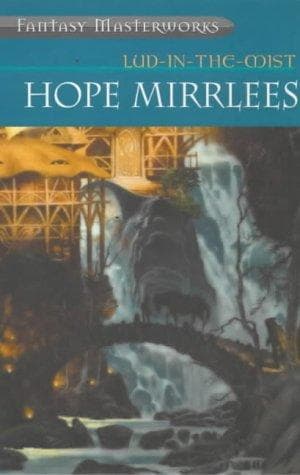
Fairies -- Fiction; Fantasy fiction; Imaginary places -- Fiction
Master Nathaniel, of course, had a well-stored cellar, and the evening
began with glasses of delicious wild-thyme gin, a cordial for which
that cellar was famous. But, as well, he had a share in a common
cellar, owned jointly by all the families of the ruling class--a
cellar of old, mellow jokes that, unlike bottles of wine, never ran
dry. Whatever there was of ridiculous or lovable in each member of
the group was distilled into one of these jokes, so that at will one
could intoxicate oneself with one's friends' personalities--swallow,
as it were, the whole comic draught of them. And, seeing that in these
old jokes the accumulated irritation that inevitably results from
intimacy evaporated and turned to sweetness, like the juice of the
grape they promoted friendship and cordiality--between the members of
the group, that is to say. For each variety of humour is a sort of
totem, making at once for unity and separation. Its votaries it unites
into a closely-knit brotherhood, but it separates them sharply off
from all the rest of the world. Perhaps the chief reason for the lack
of sympathy between the rulers and the ruled in Dorimare was that, in
humour, they belonged to different totems.
Anyhow, everyone there tonight shared the same totem, and each one of
them was the hero of one of the old jokes. Master Nathaniel was asked
if his crimson velvet breeches were a blackish crimson because, many
years ago, he had forgotten to go into mourning for his father-in-law;
and when Dame Marigold had, finally, tentatively pointed out to him his
omission, he had replied angrily, "I am in mourning!" Then, when with
upraised eyebrows she had looked at the canary-coloured stockings that
he had just purchased, he had said sheepishly, "Anyhow, it's a blackish
canary."
Few wines have as strong a flavour of the grape as this old joke had of
Master Nathaniel. His absent-mindedness was in it, his power of seeing
things as he wanted them to be (he had genuinely believed himself to
be in mourning) and, finally, in the "blackish canary" there was the
tendency, which he had inherited, perhaps, from his legal ancestors,
to believe that one could play with reality and give it what shape one
chose.
Then, Master Ambrose Honeysuckle was asked whether the Honeysuckles
considered a Moongrass cheese to be a cheese; the point being that
Master Ambrose had an exaggerated sense of the importance of his own
family, and once in the law-courts, when the question arose as to
whether a dragon (there were still a few harmless, effete dragons
lurking in caves in out-of-the-way parts of Dorimare) were a bird or a
reptile, he had said, with an air of finality, "The Honeysuckles have
always considered them to be reptiles." And his wife, Dame Jessamine,
was asked if she wanted her supper "on paper," owing to her habit of
pinning her husband down to any rash promise, such as that of a new
barouche, by saying, "I'd like that on paper, Ambrose."
Public-domain text, read in full here on John Shaqi.
Reviews
Reviews
No reviews yet
Be the first to share your thoughts on this work.
Join the Discussion
Join the discussion
Sign in to leave a comment or review.
Sign InorCreate an account