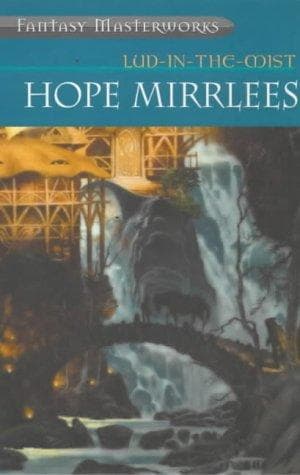
Fairies -- Fiction; Fantasy fiction; Imaginary places -- Fiction
Among the Chanticleers' lumber there was also no lack of those
delicate, sophisticated toys--fans, porcelain cups, engraved
seals--that, when the civilisation that played with them is dead,
become pathetic and appealing, just as tunes once gay inevitably
become plaintive when the generation that first sang them has turned
to dust. But those particular toys, one felt, could never have been
really frivolous--there was a curious gravity about their colouring and
lines. Besides, the moral of the ephemeral things with which they were
decorated was often pointed in an aphorism or riddle. For instance,
on a fan painted with wind-flowers and violets were illuminated these
words: "Why is Melancholy like Honey? Because it is very sweet, and it
is culled from Flowers."
These trifles clearly belonged to a later period than the masks and
costumes. Nevertheless, they, too, seemed very remote from the daily
life of the modern Dorimarites.
Well, when they had whitened their faces with flour and decked
themselves out to look as fantastic as possible, Master Nathaniel
seized one of the old instruments, a sort of lute ending in the carving
of a cock's head, its strings rotted by damp and antiquity, and,
crying out, "Let's see if this old fellow has a croak left in him!"
plucked roughly at its strings. They gave out one note, so plangent,
blood-freezing and alluring, that for a few seconds the company stood
as if petrified.
Then one of the girls saved the situation with a humourous squawk, and,
putting her hands to her ears, cried, "Thank you, Nat, for your cat's
concert! It was worse than a squeaking slate." And one of the young
men cried laughingly, "It must be the ghost of one of your ancestors,
who wants to be let out and given a glass of his own claret." And the
incident faded from their memories--but not from the memory of Master
Nathaniel.
He was never again the same man. For years that note was the apex of
his nightly dreams; the point towards which, by their circuitous and
seemingly senseless windings, they had all the time been converging.
It was as if the note were a living substance, and subject to the law
of chemical changes--that is to say, as that law works in dreams. For
instance, he might dream that his old nurse was baking an apple on the
fire in her own cosy room, and as he watched it simmer and sizzle she
would look at him with a strange smile, a smile such as he had never
seen on her face in his waking hours, and say, "But, of course, you
know it isn't really the apple. It's the Note."
The influence that this experience had had upon his attitude to daily
life was a curious one. Before he had heard the note he had caused his
father some uneasiness by his impatience of routine and his hankering
after travel and adventure. He had, indeed, been heard to vow that
he would rather be the captain of one of his father's ships than the
sedentary owner of the whole fleet.
Public-domain text, read in full here on John Shaqi.
Reviews
Reviews
No reviews yet
Be the first to share your thoughts on this work.
Join the Discussion
Join the discussion
Sign in to leave a comment or review.
Sign InorCreate an account