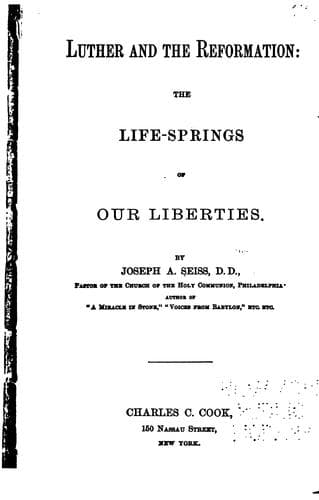
Luther and the Reformation:: The Life-Springs of Our LibertiesSeiss, Joseph Augustus
History
Luther and the Reformation:: The Life-Springs of Our Liberties
Seiss, Joseph Augustus
Luther, Martin, 1483-1546; Pennsylvania -- History -- Colonial period, ca. 1600-1775
The plan of this illustrious king was to found here upon the Delaware
a free state under his sovereign protection, where the laborer should
enjoy the fruit of his toil, where the rights of conscience should be
preserved inviolate, and which should be open to the whole Protestant
world, then and for long time engaged in bloody conflict with the
papal powers for the maintenance of its existence. Here all were to be
secure in their persons, their property, and their religious
convictions. It was to be a place of refuge and peace for the
persecuted of all nations, of security for the honor of the wives and
daughters of those fleeing from sword, fire, and rapine, and from
homes made desolate by oppressive war. It was to be a land of
universal liberty for all classes, the soil of which was never to be
burdened with slaves.[32] And in all the colonies of America there was
not a more thoroughly digested system for the practical realization
of these ideas than that which the great Gustavus Adolphus had thus
arranged.
Nor did it altogether die with his death. His mantle fell upon one of
the best and greatest of men. Axel Oxenstiern, his friend and prime
minister, and his successor in the administration of the affairs of
the kingdom, was as competent as he was zealous to fulfill the wise
plans and ideas of the slain king, not only with reference to Sweden
and Europe, but also with regard to the contemplated colony in
America.
Having taken the matter into his own hands, on the 10th of April,
1633, only a few months after Gustavus's death, Oxenstiern renewed the
movement which had been laid aside, and repeated the offer to Germany
and other countries, inviting general co-operation in the noble
enterprise.
Peter Minuit, a member of a distinguished family of Rhenish Prussia,
who had been for years the able director and president of the Dutch
mercantile establishment on the Hudson, presented himself in Sweden,
and entered into the matter with great energy and enthusiasm. And by
the end of 1637 or early in 1638 two ships were seen entering and
ascending the Delaware, freighted with the elements and nucleus of
the new state, such as Gustavus had projected.
These ships, under Minuit, landed their passengers but a few miles
south of where Philadelphia now stands, and thus made the first
beginning of what has since become the great and happy Commonwealth of
Pennsylvania.
This was _six years before Penn was born_.
FOOTNOTES:
[32] The description of the features of this plan is taken from
Geijer's _Svenska Folkets Historia_, vol. iii. p. 128, given by Dr.
Reynolds in his Introduction to Israel Acrelius's _History of New
Sweden_, published by the Historical Society of Pennsylvania. It was
first propounded by Gustavus Adolphus in 1624. Also referred to in
_Argonautica Gustaviana_, pp. 3 and 22.
WAS PENN AWARE OF THESE PLANS?
Public-domain text, read in full here on John Shaqi.
Reviews
Reviews
No reviews yet
Be the first to share your thoughts on this work.
Elsewhere in the archive
Join the Discussion
Join the discussion
Sign in to leave a comment or review.
Sign InorCreate an account