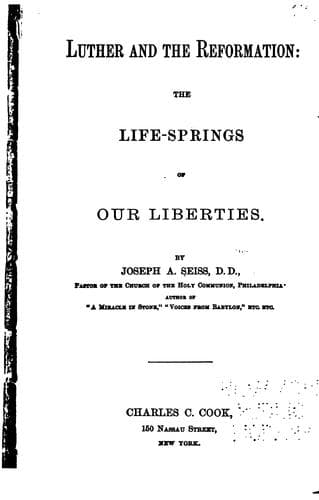
Luther and the Reformation:: The Life-Springs of Our LibertiesSeiss, Joseph Augustus
History
Luther and the Reformation:: The Life-Springs of Our Liberties
Seiss, Joseph Augustus
Luther, Martin, 1483-1546; Pennsylvania -- History -- Colonial period, ca. 1600-1775
How far William Penn was illuminated and influenced by the ideas of
the great and wise Gustavus Adolphus in reference to the founding of a
free state in America as an asylum for the persecuted and suffering
people of God in the Old World, is nowhere told; but there is reason
to believe that he knew of them, and took his own plans from them.
A few facts bearing on the point may here be noted.
One peculiarly striking is, that the same plan and principles with
reference to such a colonial state which Penn brought hither in the
_Welcome_ in 1682 were already matured and widely propounded by the
illustrious Swedish king more than half a century before they
practically entered Penn's mind.
Another is, that these proposals and principles were generally
promulgated throughout Europe--first by Gustavus and those associated
with him in the matter, and then again by Oxenstiern, in Germany,
Holland, and other countries.
Still another is, that in 1677 Penn made a special tour of three
months through Holland and various parts of Germany, visiting and
conferring with many of the most pious and devoted people, including
distinguished men and women, and clergy and laity of high standing,
information, and influence. He made considerable stay in Frankfort,
where he says both Calvinists and Lutherans received him with gladness
of heart. He visited Mayence, Worms, Mannheim, Mulheim, Duesseldorf,
Herwerden, Embaden, Bremen, etc., etc., concerning which the editor of
his _Life and Writings_ says he had "interesting interviews with many
persons eminent for their talents, learning, or social position."
Among them were such as Elizabeth, Princess Palatine, niece of Charles
I. of England and the daughter of the king of Bohemia, the special
friend of Gustavus Adolphus, who died of horror on hearing that
Gustavus was slain; Anna Maria, countess of Hornes; the countess and
earl of Falkenstein and Brueck; the president of the council of state
at Embaden; the earl of Donau, and the like; among all of which it is
hardly possible that he should have failed to meet with the proposals
which had gone out over all Protestant Europe from the throne of
Sweden. Nor is there any evidence that William Penn had thought of
founding a free Christian state in America until immediately after his
return to England from this tour on the Continent.
Furthermore, the plans of Gustavus respecting his projected colony on
the Delaware were well understood in official circles in England
itself, especially in London, from 1634. John Oxenstiern, brother of
the great chancellor, was at that time Swedish ambassador in London,
and in that year he obtained from King Charles I. a renunciation and
cession to Sweden of all claims of the English to the country on the
Delaware growing out of the rights of first discovery, and for the
very purposes of this colonial free state and asylum first projected
by the Swedish king.
THE SWEDES IN ADVANCE OF PENN.
Public-domain text, read in full here on John Shaqi.
Reviews
Reviews
No reviews yet
Be the first to share your thoughts on this work.
Elsewhere in the archive
Join the Discussion
Join the discussion
Sign in to leave a comment or review.
Sign InorCreate an account