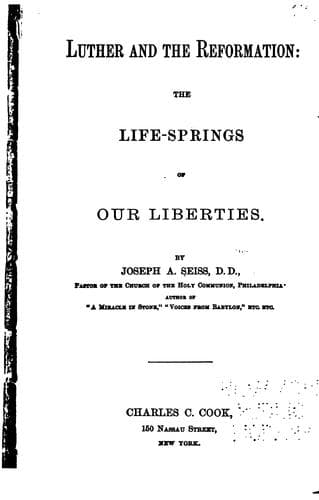
Luther and the Reformation:: The Life-Springs of Our LibertiesSeiss, Joseph Augustus
History
Luther and the Reformation:: The Life-Springs of Our Liberties
Seiss, Joseph Augustus
Luther, Martin, 1483-1546; Pennsylvania -- History -- Colonial period, ca. 1600-1775
Penn was accompanied by from sixty to seventy colonists--all that
survived the scourge which visited them in their passage across the
sea. He landed first at New Castle, of which the Dutch of New York had
by conquest obtained possession. To them he made known his grants and
his plans, and succeeded in securing their acquiescence in them.
Thence he came to Upland (Chester), the head-quarters of the Swedes,
who "received their new fellow-citizens with great friendliness,
carried up their goods and furniture from the ships, and entertained
them in their own houses without charge." His proposals with regard to
the establishment of a united commonwealth they also received with
much favor. And immediately thereupon he convened a general assembly
of the citizens, which sat for three days, by which an act was passed
for the consolidation of the various interests and parties on the
ground, a code of general regulations adopted, and the necessary
features of a common government enacted; all of which together formed
the basis of our present commonwealth.
HOW PENNSYLVANIA WAS NAMED.
The name which Penn had chosen for the territory of his grant was
_Sylvania_, but the king prefixed the name of Penn and called it
_Penn's_ Silvania (_Penn's Woods_), in honor of the recipient's
father, Sir William Penn, a distinguished officer in the British navy.
Penn sought to have the title changed so as to leave his own name out,
as he thought it savored too much of personal vanity; but his efforts
did not avail. And thus our great old commonwealth took the name of
_Pennsylvania_, and the city of Philadelphia was laid out and named by
Penn himself as its capital.
THE MEN OF THOSE TIMES.
In dwelling upon the founding of our happy commonwealth it is pleasant
to contemplate how enlightened and exalted were the men whom
Providence employed for the performance of this important work.
Many are apt to think ours the age of culminated enlightenment,
dignity, wisdom, and intelligence, and look upon the fathers of two
and three hundred years ago as mere pigmies, just emerging from an era
of barbarism and ignorance, not at all to be compared with the proud
wiseacres of our day. Never was there a greater mistake. The
shallowness and flippancy of the leaders and politicians of this last
quarter of the nineteenth century show them but little more than
school-boys compared with the sturdy, sober-minded, deep-principled,
dignified, and grand-spirited men who discovered and opened this
continent and laid the foundations of our country's greatness. And
those who were most concerned in the founding of our own commonwealth
suffer in no respect in comparison with the greatest and the best.
GUSTAVUS ADOLPHUS.
Public-domain text, read in full here on John Shaqi.
Reviews
Reviews
No reviews yet
Be the first to share your thoughts on this work.
Elsewhere in the archive
Join the Discussion
Join the discussion
Sign in to leave a comment or review.
Sign InorCreate an account