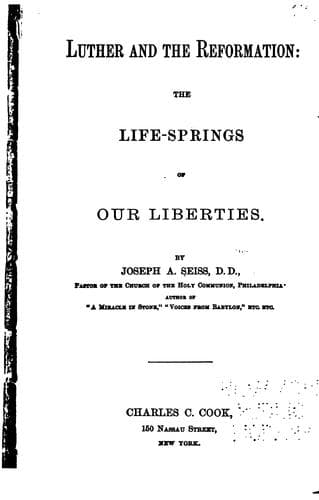
Luther and the Reformation:: The Life-Springs of Our LibertiesSeiss, Joseph Augustus
History
Luther and the Reformation:: The Life-Springs of Our Liberties
Seiss, Joseph Augustus
Luther, Martin, 1483-1546; Pennsylvania -- History -- Colonial period, ca. 1600-1775
We are left to our own inferences from these facts. But, however much
or little Penn may have been directly influenced and guided by what
Gustavus Adolphus had conceived and elaborated on the subject, the
wise and noble conception which he brought with him for practical
realization in 1682 was known to the European peoples for more than
fifty years before he laid hold on it. The same had also been one of
the chief sources of the inspiration of Lord Baltimore in the founding
of the colony of Maryland, of which Penn was not ignorant. And the
same, not unknown to him, had already begun to be realized here in
what is now called Pennsylvania full forty-four years before his
arrival.
Shipload after shipload of sturdy and devoted people, mostly Swedes,
animated with the same grand ideas, had here been landed. And so
successfully had they battled with the perils and hardships of the
wilderness, and so justly had they treated and arranged to dwell in
peace and love with the wild inhabitants of the forests, that when
Penn came he found everything prepared to his hand. The Swedes alone
already numbered about one thousand strong. They had conquered the
wild woods, built them homes, and opened plantations; and "the eye of
the stranger could begin to gaze with interest upon the signs of
public improvement, ever regularly advancing, from the region of
Wilmington to that of Philadelphia."
When Penn landed he found a town and court-house at New Castle, and a
town and place of public assemblage at Upland, and a Christian and
free people in possession of the territory, with whom it was necessary
for him to treat before his charter could avail for the planting of
his colony. The land to which the Swedes had acquired title (by
England's release to Sweden of all claim from right of discovery, by
charter from Sweden, by purchase from the Indians, first under Minuit,
the first governor, and then under his successor, Governor Printz, and
by other purchases or agreements) was the west bank of the Delaware
River from Cape Henlopen to Trenton Falls, and thence westward to the
great fall in the Susquehanna, near the mouth of the Conewaga Creek,
which included nearly the whole of Eastern Pennsylvania and Delaware.
The fortunes of war, in Europe and between the colonies, in course of
time complicated the titles to one and another portion of this
territory, but the Swedes and Dutch occupied and held the most
prominent parts of it by right of actual possession when and after
Penn's charter was granted.
PENN'S CHARTER AND ARRIVAL.
But when Penn arrived he brought with him letters patent from Charles
II., king of England, to this same district of country and the wilds
indefinitely beyond it, having also obtained from his friend, the
king's brother, the duke of York, full releases of the claims vested
in him to the "Lower Counties," which now form the State of Delaware.
Public-domain text, read in full here on John Shaqi.
Reviews
Reviews
No reviews yet
Be the first to share your thoughts on this work.
Elsewhere in the archive
Join the Discussion
Join the discussion
Sign in to leave a comment or review.
Sign InorCreate an account