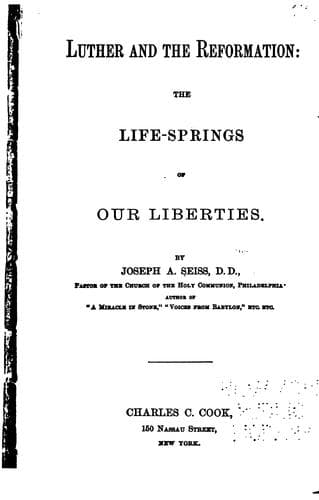
Luther and the Reformation:: The Life-Springs of Our LibertiesSeiss, Joseph Augustus
History
Luther and the Reformation:: The Life-Springs of Our Liberties
Seiss, Joseph Augustus
Luther, Martin, 1483-1546; Pennsylvania -- History -- Colonial period, ca. 1600-1775
As the Quaker tenets respected the state as well as religion, the bold
avowal of them brought him into collision with the laws, and several
times into prison and banishment. But, so far from intimidating him,
this only the more confirmed him in his convictions and fervency. By
his familiarity with able theologians, such as Dr. Owen and Bishop
Tillotson, as well as from his own studies of the Scriptures, he was
deeply grounded in the main principles of the evangelic faith. Indeed,
he was in many things, in his later life, much less a Quaker than many
who glory in his name, and all his sons after him found their
religious home in the Church of England, which, to Quakers generally,
was a very Babylon. But he was an honest-minded, pure, and cultured
Christian believer, holding firmly to the inward elements of the
orthodox faith in God and Christ, in revelation and eternal judgment,
in the rights of man and the claims of justice. If some of his friends
and representatives did not deal as honorably with the Swedes in
respect to their prior titles to their improved lands as right and
charity would require, it is not to be set down to his personal
reproach. And his zeal for his sect and his genuine devotion to God
and religious liberty, together with a large-hearted philanthropy,
were the springs which moved him to seize the opportunity which
offered in the settlement of his deceased father's claim on the
government to secure a grant of territory and privilege to form a free
state in America--first for his own, and then for all other persecuted
people.
AN ESTIMATE OF PENN.
It may be that Penn has been betimes a little overrated. He has, and
deserves, a high place in the history of our commonwealth, but he was
not the real founder of it; for its foundations were laid years before
he was born and more than forty years before he received his charter.
He founded Pennsylvania only as Americus Vespucius discovered America.
Neither was he the author of those elements of free government, equal
rights, and religious liberty which have characterized our
commonwealth. They were the common principles of Luther and the
Reformation, and were already largely embodied for this very
territory[34] long before Penn's endeavors, as also, in measure, in
the Roman Catholic colony of Maryland from the same source.
Nor was he, in his own strength, possessed of so much wise forethought
and profound legislative and executive ability as that with which he
is sometimes credited. But he was a conscientious, earnest, and
God-fearing man, cultured by education and grace, gifted with
admirable address, sincere and philanthropic in his aims, and guided
and impelled by circumstances and a peculiar religious zeal which
Providence overruled to ends far greater than his own intentions or
thoughts.
FOOTNOTES:
[34] See sketch of the plan of Gustavus Adolphus for his colony, page
143, and the instructions given to Governor Printz in 1642.
PENN AND THE INDIANS.
Public-domain text, read in full here on John Shaqi.
Reviews
Reviews
No reviews yet
Be the first to share your thoughts on this work.
Elsewhere in the archive
Join the Discussion
Join the discussion
Sign in to leave a comment or review.
Sign InorCreate an account