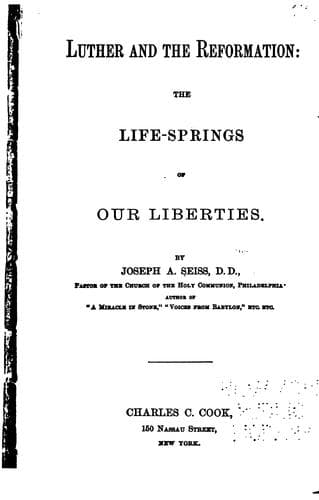
Luther and the Reformation:: The Life-Springs of Our LibertiesSeiss, Joseph Augustus
History
Luther and the Reformation:: The Life-Springs of Our Liberties
Seiss, Joseph Augustus
Luther, Martin, 1483-1546; Pennsylvania -- History -- Colonial period, ca. 1600-1775
What is called Penn's particular policy toward the Indians, and the
means of his successes in that regard, existed in practical force
scores of years before he arrived. His celebrated treaties with them,
as far as they were fact, were but continuations and repetitions
between them and the English, which had long before been made between
them and the Swedes, who did more for these barbarian peoples than he,
and who helped him in the matter more than he helped himself.
We are not fully informed respecting all the first instructions given
to Governor Minuit when he came hither with Pennsylvania's original
colony in 1637-38, but there is every reason to infer that they
strictly corresponded to those given to his successor, Governor
Printz, five years afterward, on his appointment in 1642, about which
there can be no question. Minuit entered into negotiations with the
Indians the very first thing on his landing, and purchased from them,
as the rightful proprietors, all the land on the western side of the
river from Henlopen to Trenton Falls; a deed for which was regularly
drawn up, to which the Indians subscribed their hands and marks. Posts
were also driven into the ground as landmarks of this treaty, which
were still visible in their places sixty years afterward.
In the appointment and commission of Governor Printz it was commanded
him to "bear in mind the articles of contract entered into with the
wild inhabitants of the country as its rightful lords." "The wild
nations bordering on all other sides the governor shall understand how
to treat with all humanity and respect, that no violence, or wrong be
done them; but he shall rather at every opportunity exert himself that
the same wild people may gradually be instructed in the truths and
worship of the Christian religion, and in other ways brought to
civilization and good government, and in this manner properly guided.
Especially shall he seek to gain their confidence, and impress upon
their minds that neither he, the governor, nor his people and
subordinates, are come into those parts to do them any wrong or
injury."
This policy was not a thing of mere coincidence. It was the express
stipulation and command of the throne of Sweden, August 15, 1642,
which was two years before William Penn was born; and "this policy was
steadily pursued and adhered to by the Swedes during the whole time of
their continuance in America, as the governors of the territory of
which they had thus acquired the possession; and the consequences were
of the most satisfactory character. They lived in peace with the
Indians, and received no injuries from them. The Indians respected
them, and long after the Swedish power had disappeared from the shores
of the Delaware they continued to cherish its memory and speak of it
with confidence and affection."[35]
Public-domain text, read in full here on John Shaqi.
Reviews
Reviews
No reviews yet
Be the first to share your thoughts on this work.
Elsewhere in the archive
Join the Discussion
Join the discussion
Sign in to leave a comment or review.
Sign InorCreate an account