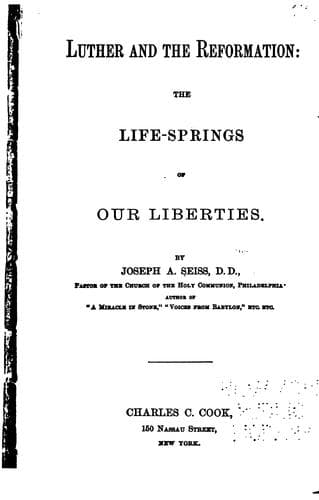
Luther and the Reformation:: The Life-Springs of Our LibertiesSeiss, Joseph Augustus
History
Luther and the Reformation:: The Life-Springs of Our Liberties
Seiss, Joseph Augustus
Luther, Martin, 1483-1546; Pennsylvania -- History -- Colonial period, ca. 1600-1775
But still, as a man, a colonist, a governor, and a friend of the race,
we owe to William Penn great honor and respect, and his arrival here
is amply worthy of our grateful commemoration. The location and
framing of this goodly city, and a united and consolidated
Pennsylvania established finally in its original principles of common
rights and common freedom, are his lasting monument. If he was not
the spring of our colonial existence, he was its reinforcement by a
strong and fortunate stream, which more fully determined the channel
of its history. If the doctrine of liberty of conscience and religion,
the principles of toleration and common rights, and the embodying of
them in a free state open to all sufferers for conscience' sake, did
not originate with him, he performed a noble work and contributed a
powerful influence toward their final triumph and permanent
establishment on this territory. And his career, taken all in all,
connects his name with an illustrious service to the cause of freedom,
humanity, and even Christianity, especially in its more practical and
ethical bearings.
THE GREATNESS OF FAITH.
Such, then, were the men most concerned in founding and framing our
grand old commonwealth. They were men of faith, men of thorough
culture, men of mark by birth and station, men who had learned to
grapple with the great problem of human rights, human happiness, human
needs, and human relations to heaven and earth. They believed in God,
in the revelation of God, in the Gospel of Christ, in the
responsibility of the soul to its Maker, and in the demands of a
living charity toward God and all his creatures. And their religious
faith and convictions constituted the fire which set them in motion
and sustained and directed their exertions for the noble ends which it
is ours so richly to enjoy. Had they not been the earnest Christians
that they were, they never could have been the men they proved
themselves, nor ever have thought the thoughts or achieved the
glorious works for ever connected with their names.
Public-domain text, read in full here on John Shaqi.
Reviews
Reviews
No reviews yet
Be the first to share your thoughts on this work.
Elsewhere in the archive
Join the Discussion
Join the discussion
Sign in to leave a comment or review.
Sign InorCreate an account