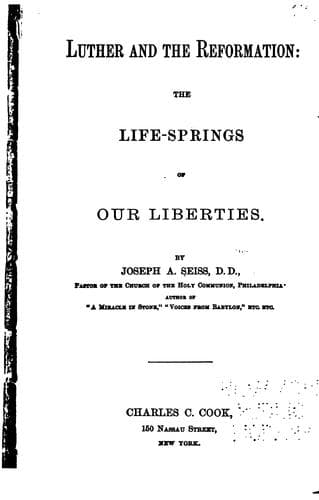
Luther and the Reformation:: The Life-Springs of Our LibertiesSeiss, Joseph Augustus
History
Luther and the Reformation:: The Life-Springs of Our Liberties
Seiss, Joseph Augustus
Luther, Martin, 1483-1546; Pennsylvania -- History -- Colonial period, ca. 1600-1775
When Mr. Rising became governor of the Swedish colony he invited ten
Indian chiefs, or kings, to a friendly conference with him. It was
held at Tinicum, on the Delaware, June 17, 1654, when the governor
saluted them, in the name of the Swedish queen, with assurances of
every kindness toward them, and proposed to them a firm renewal of the
old friendship. Campanius has given a minute account of this
conference, and recites the speech in which one of the chiefs, named
Naaman, testified how good the Swedes had been to them; that the
Swedes and Indians had been in the time of Governor Printz as one body
and one heart; that they would henceforward be as one head, like the
calabash, which has neither rent nor seam, but one piece without a
crack; and that in case of danger to the Swedes they would ever serve
and defend them. It was at the same time further arranged and agreed
that if any trespasses were committed by any of their people upon the
property of the Swedes, the matter should be investigated by men
chosen from both sides, and the person found guilty "should be
punished for it as a warning to others."[38] This occurred when
William Penn was but ten years of age, and twenty-eight years before
his arrival in America.
And upon the subject of the help which the Swedes rendered to Penn in
his dealings with these people in the long after years, Acrelius
writes: "The Proprietor ingratiated himself with the Indians. The
Swedes acted as his interpreters, especially Captain Lars (Lawrence)
Kock, who was a great favorite among the Indians. He was sent to New
York to buy goods suitable for traffic. He did all he could to give
them a good opinion of their new ruler" (p. 114); and it was by means
of the aid and endeavors of the Swedes, more than by any influence of
his own, that Penn came to the standing with these people to which he
attained, and on which his fame in that regard rests.
FOOTNOTES:
[35] Introduction to Acrelius's _History_.
[36] _Swedish Annals_, p. 26.
[37] Dr. Reynolds's _Introduction to Acrelius_, p. 14.
[38] See Acrelius's _History_, pp. 64, 65, and Clay's _Swedish
Annals_, pp. 24, 25.
PENN'S WORK.
Public-domain text, read in full here on John Shaqi.
Reviews
Reviews
No reviews yet
Be the first to share your thoughts on this work.
Elsewhere in the archive
Join the Discussion
Join the discussion
Sign in to leave a comment or review.
Sign InorCreate an account