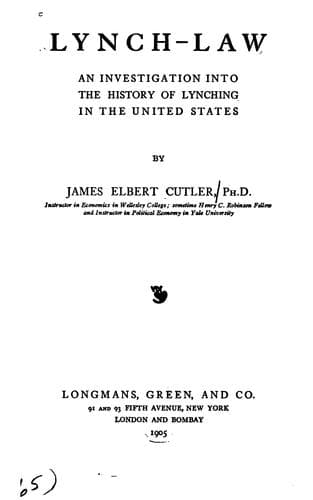
Lynch-law; an investigation into the history of lynching in the United StatesCutler, James Elbert
Philosophy
Lynch-law; an investigation into the history of lynching in the United States
Cutler, James Elbert
Lynching -- United States
For more than a century the principle laid down by the legislature of
Virginia has been appealed to as a justification for recourse to
lynch-law. In Revolutionary times it was held that the immediate urgency
and imminent danger of the situation justified the summary and
extra-legal measures that were taken to suppress conspiracies against
American patriots. On the frontier it was urged that the imminence of
the danger warranted summary procedure against desperadoes and
marauders, at first merely whipping and banishment, later hanging and
summary execution. In the time of the anti-slavery agitation
circumstances had arisen under which measures, though not strictly
warranted by law, were held to be justifiable from the nature of the
offense. In the opinion of the slave-holder summary treatment in the
form of flogging, tarring and feathering, and banishing the abolitionist
was wholly justifiable. The doctrine that “when the law is inefficient
to take hold of a man the people should” was again and again referred to
in support of the summary punishment of the abolitionists.
Hidden away in Judge Lawless’s charge to the St. Louis grand jury is the
same principle.[223] If the lawless violence was the work of the “many,”
if it was committed by a representative number of the citizens while in
a state of frenzy and excitement, it must be considered beyond the reach
of human law. In 1839, W. E. Channing stated the principle in the
following words: “Undoubtedly there may be crimes, so unnatural, so
terrible to a community, that a people may be forgiven, if, deeming the
usual forms of justice too slow, they assume the perilous office of
inflicting speedy punishment.... There is, indeed, as I have intimated,
one case where popular commotion does comparatively little harm, I mean
that which is excited by some daring crime, which the laws sternly
forbid, and which sends an electric thrill of horror through a virtuous
community. In such a case, the public without law do the work of law,
and enforce those natural, eternal principles of right, on which all
legislation should rest.”[224]
Governor Lynch, of Mississippi, in his message to the State legislature
in 1836, used the following language with reference to the hanging of
the Vicksburg gamblers: “However we may regret the occasion, we are
constrained to admit that necessity will sometimes prompt a summary mode
of trial and punishment unknown to the law.”[225]
A few years later Captain Marryat wrote:
Public-domain text, read in full here on John Shaqi.
Reviews
Reviews
No reviews yet
Be the first to share your thoughts on this work.
Elsewhere in the archive
Join the Discussion
Join the discussion
Sign in to leave a comment or review.
Sign InorCreate an account