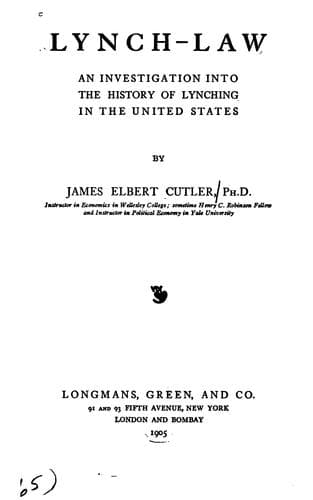
Lynch-law; an investigation into the history of lynching in the United StatesCutler, James Elbert
Philosophy
Lynch-law; an investigation into the history of lynching in the United States
Cutler, James Elbert
Lynching -- United States
“Englishmen express their surprise that in a moral community such a
monstrosity as Lynch law should exist; but although the present
system, which has been derived from the original Lynch law, cannot be
too severely condemned, it must, in justice to the Americans, be
considered that the original custom of Lynch law was forced upon them
by circumstances.... In its origin the practice was no more blameable
than were the laws established by the Pilgrim fathers on their first
landing at Plymouth, or any law enacted amongst a community left to
themselves, their own resources, and their own guidance and
government. Lynch law, as at first constituted, was nothing more than
punishment awarded to offenders by a community who had been injured,
and who had no law to refer to, and could have no redress if they did
not take the law into their own hands; the _present_ system of Lynch
law is, on the contrary, an illegal exercise of the power of the
majority in opposition to and defiance of the laws of the country, and
the measure of justice administered and awarded by those laws.
“It must be remembered that fifty years ago, there were but few white
men to the westward of the Alleghany Mountains; that the States of
Kentucky and Tennessee were at that time as scanty in population as
even now are the districts of Ioway and Columbia; that by the
institutions of the Union a district required a certain number of
inhabitants before it could be acknowledged as even a district; and
that previous to such acknowledgment, the people who had _squatted_ on
the land had no claim to protection or law. It must also be borne in
mind, that these distant territories offered an asylum to many who
fled from the vengeance of the laws, men without principle, thieves,
rogues, and vagabonds, who escaping there, would often interfere with
the happiness and peace of some small yet well-conducted community,
which had migrated and settled on these fertile regions. These
communities had no appeal against personal violence, no protection
from rapacity and injustice. They were not yet within the pale of the
Union....
“It was, therefore, to remedy the defect of there being no established
law, that Lynch law, as it is termed, was applied to; without it, all
security, all social happiness would have been in a state of abeyance.
By degrees, all disturbers of the public peace, all offenders against
justice met with their deserts; and it is a query, whether on its
first institution, any law from the bench was more honestly and
impartially administered than this very Lynch law, which has now had
its name prostituted by the most barbarous excesses and contemptuous
violation of all law whatever. The examples I am able to bring forward
of Lynch law, in its primitive state, will all be found to have been
based upon necessity, and a due regard to morals and to justice.”[226]
Public-domain text, read in full here on John Shaqi.
Reviews
Reviews
No reviews yet
Be the first to share your thoughts on this work.
Elsewhere in the archive
Join the Discussion
Join the discussion
Sign in to leave a comment or review.
Sign InorCreate an account