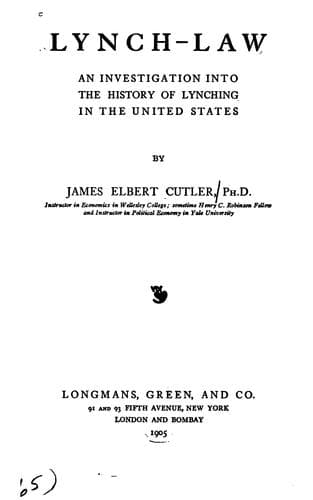
Lynch-law; an investigation into the history of lynching in the United StatesCutler, James Elbert
Philosophy
Lynch-law; an investigation into the history of lynching in the United States
Cutler, James Elbert
Lynching -- United States
In Maryland, in 1739, “two slaves of Anne Arundel were executed, one for
burglary, the other for rape on a white woman; and the body of the
second, who had been a notorious offender, was hung in chains at some
distance from the gallows.”[252]
In Somerset County, New Jersey, in the year 1744, a young negro was
burnt alive for ravishing a white child about nine years old.[253]
The punishment of burning alive, which was sometimes applied to negroes
by the courts during the colonial period, was, however, usually
inflicted for other offenses than rape, such as murder or conspiracy to
murder (particularly by the use of poison), insurrection, and
arson.[254] But this punishment was never applied to negroes during the
colonial period except by judicial decree. Indeed, with the possible
exception of the slave insurrection in South Carolina in 1740,[255]
there are no instances recorded in colonial history where slaves were
publicly executed without trial.[256] Both by law and by public
sentiment slaves were recognized as chattels, and when they were
executed for crimes for the commission of which the owners could in no
way be held responsible, such owners were entitled to indemnification
and could enter suit at law for damages. It was customary for the courts
when passing sentence of death upon a slave to fix the valuation of the
slave, and this sum was then paid to the owner.
There is evidence to show that this crime directed against white women
continued to be perpetrated down to the time of the Civil War. The Salem
(Mass.) Gazette for October 5, 1813, contained this item: “At the late
term of the Supreme Judicial Court, holden at Northampton, Peter Pyner,
a black man, was convicted of a Rape, committed on the body of a _white
female_. The circumstances of the case were of a very distressing
nature, and the evidence of his guilt clear beyond a question. Sentence
of Death was pronounced by his Honor Chief Justice Parsons, in a solemn
and affecting manner.”
The Richmond Enquirer of December 14, 1813, gives an account of the
killing of a negro slave by a white woman in defense of her virtue.[257]
The following passages are taken from Niles’ Register in the years 1821
and 1822. “_A Monster._ A negro fellow, armed with a gun, seized upon a
respectable married lady, near Cartersville, Va., and attempted to
commit a rape on her. After a long contest, she succeeded in getting out
of his clutches, when he fired at her, but missed his aim. About an hour
afterwards, he in like manner attacked another married lady—not
succeeding, after a desperate struggle, he attempted to kill her with a
knife, but she wrested it from him, and getting released, ran away, when
he fired at her and lodged many shot in the back of her neck and
head—and yet, thus wounded, she escaped. The fellow declared his
intention of thus serving all the white women he could meet with. A
reward is offered for his apprehension.”[258]
Public-domain text, read in full here on John Shaqi.
Reviews
Reviews
No reviews yet
Be the first to share your thoughts on this work.
Elsewhere in the archive
Join the Discussion
Join the discussion
Sign in to leave a comment or review.
Sign InorCreate an account