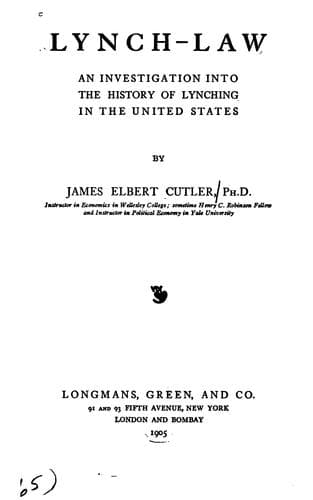
Lynch-law; an investigation into the history of lynching in the United StatesCutler, James Elbert
Philosophy
Lynch-law; an investigation into the history of lynching in the United States
Cutler, James Elbert
Lynching -- United States
In 1721 Delaware passed “An Act for the Trial of Negroes” the provisions
of which were similar to those of the law of Pennsylvania enacted in
1705. Two justices of the peace, “particularly commissionated by the
Governor for that service within the respective counties thereof,” and
six of the most substantial freeholders of the neighborhood, were to
hear, examine, try and determine offenses committed by negro or mulatto
slaves, and it was provided that “if any Negro or Mulatto slave ...
shall attempt to commit a rape on a white woman or maid, they shall be
tried in manner aforesaid, and shall be punished by standing four hours
in the pillory at the Court-House on some court day, with both ears
nailed to the pillory, and before he be taken down from the same shall
have both his ears cut off close to his head.”[247]
By an act of June 8, 1751, it became the law of Maryland “that if any
slave or slaves shall at any time consult, advise, conspire or attempt
to raise any insurrection within this province, or to murder or poison
any person or persons whatsoever, or to commit a rape upon any white
woman, or to burn any house or houses, and be thereof convict by
confession or verdict ... shall suffer death, as in cases of felony,
without benefit of clergy.”[248]
In North Carolina, in 1758, the Assembly resolved to try “a plan which
would save the lives of the slaves and still act as a deterrent from
further crimes.” It was enacted “that except for rape or murder no male
slave who had committed a crime which was ordinarily punished by death
should suffer death for the first offence; but that on due conviction
such an offender should be castrated, the sheriff to be allowed for the
operation twenty shillings to be paid by the public. The court must fix
the value of the slave before the execution of this sentence, so that if
it should be the cause of his death there might be no dispute as to the
value to be paid his master. Three pounds were allowed by the public for
the curing of the slave’s wounds. For the second offence death might be
the penalty.”[249]
Foregoing further quotation and reference, the statement may be made
that in the colonial period, when laws were enacted for the trial and
punishment of offenses committed by negroes upon whites, rape was
usually one of the offenses for which capital punishment was provided,
and considerable discretion was generally allowed the judicial
authorities as to the manner in which the penalty should be inflicted,
the methods of hanging and burning alive both being employed.
In Massachusetts, in the year 1676, Basto, a negro slave, was sentenced
to be hanged for rape on the daughter of his master.[250]
In New Jersey, in the year 1731, “a negro slave called Harry, ravished
Annatye Pryers, but, apparently without exercising much force; sentenced
to receive forty-one lashes and to be branded on the right shoulder with
the letter ‘B.’”[251]
Public-domain text, read in full here on John Shaqi.
Reviews
Reviews
No reviews yet
Be the first to share your thoughts on this work.
Elsewhere in the archive
Join the Discussion
Join the discussion
Sign in to leave a comment or review.
Sign InorCreate an account