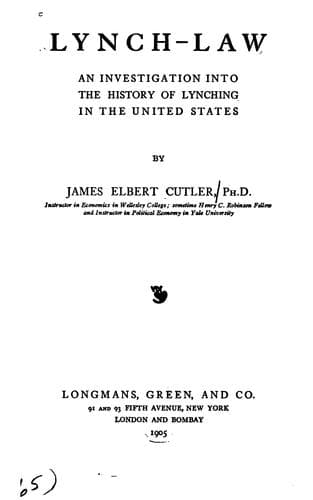
Lynch-law; an investigation into the history of lynching in the United StatesCutler, James Elbert
Philosophy
Lynch-law; an investigation into the history of lynching in the United States
Cutler, James Elbert
Lynching -- United States
Such evidence shows that the crime of rape directed against white women
was not unknown prior to 1860.[262] As regards other crimes frequently
committed by negroes during the period of slavery, apparently it formed
a rather small proportion. It was far from being a crime that was more
frequently committed than any other, and yet it was one for the
perpetration of which the negroes showed a marked propensity whenever an
opportunity presented itself. Under the institution of slavery, however,
such opportunities were few. From the nature of slavery, the negro
seldom had an opportunity to ravish a white woman. The strong, burly
negro who was considered dangerous and likely to commit violence was
ordinarily put at hard labor in the fields and kept under strict
surveillance. Also, the discipline to which the negro was subjected when
a slave gave him a mastery over himself which it has been extremely
difficult for him to obtain by his own efforts. Habits of obedience and
industry, however inculcated, go very far toward restraining criminal
impulses. The good effects of the discipline of the slave régime were
particularly manifest during the progress of the Civil War, when the
Southern planters were obliged to leave their families with no other
protectors than the slaves, and these slaves discharged their trust with
uniform faithfulness and loyalty.
From the colonial period to the beginning of the anti-slavery agitation
in the early thirties, the law was regularly allowed to take its course
in dealing with negro criminals. Very little inclination was shown on
the part of the people to inflict punishment otherwise than as was then
provided by law. With regard to the crime of rape two instances may be
cited where summary measures were employed.
Niles’ Register for November 15, 1823 (25: 176) contained this item:
“_Negro Frank_ was lately tried at Frederick, Maryland, for having
defloured a young white female. That the fact had taken place, and as
stated, in the most brutal manner, was admitted; but Frank was acquitted
for the want of sufficient proof of his person. Some of the people,
however, thought he was guilty—and, after his release, he was beaten so
severely, as almost to deprive him of life.”
The following item appeared in Niles’ Register for March 10, 1832 (42:
22): “A negro fellow lately committed a horrid outrage on the body of a
girl twelve or thirteen years old, the daughter of a respectable
gentleman in Dinwiddie county, Virginia, who was almost killed by his
brutality. The ravisher was caught by the father, and instantly punished
with 150 lashes, of which it was believed that he would die—if not he
would be brought to trial.”
Public-domain text, read in full here on John Shaqi.
Reviews
Reviews
No reviews yet
Be the first to share your thoughts on this work.
Elsewhere in the archive
Join the Discussion
Join the discussion
Sign in to leave a comment or review.
Sign InorCreate an account