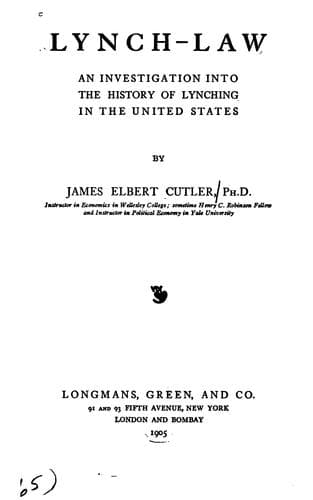
Lynch-law; an investigation into the history of lynching in the United StatesCutler, James Elbert
Philosophy
Lynch-law; an investigation into the history of lynching in the United States
Cutler, James Elbert
Lynching -- United States
That there was an increasing disposition to resort to summary methods
for the punishment of negroes during the period 1830–1860 has been shown
in the evidence cited in Chapter IV; but so far as the infliction of
summary capital punishment was concerned, that did not become a serious
evil until the time of the Reconstruction of the Southern States.
Comparatively few negroes were lynched until after the close of the War.
It may be said, therefore, that while race prejudice and the crime of
rape against white women both existed as causes for the summary
treatment of negroes prior to the Civil War, both were held in check by
the institution of slavery.
It thus appears that throughout the period of slavery there was a
greater reliance on legal procedure for the treatment of negroes accused
of heinous offenses than has been manifest since that time; and not only
did the institution of slavery directly bring about this greater
reliance on legal procedure, by the suppression of the strongest
incentives toward adopting summary and illegal procedure, but it made
possible the enactment of special laws providing for a more expeditious
trial and execution of sentence in the case of negro offenders.
In the year 1740, South Carolina made the following provision for the
trial of slaves:
“And _whereas_, natural justice forbids that any person, of what
condition soever, should be condemned unheard, and the order of civil
government requires that for the due and equal administration of
justice, some convenient method and form of trial should be
established; _Be it therefore enacted_ by the authority aforesaid,
That all crimes and offences which shall be committed by slaves in
this Province, and for which capital punishment shall or lawfully may
be inflicted, shall be heard, examined, tried, adjudged and finally
determined by any two justices assigned to keep the peace, and any
number of freeholders not less than three or more than five, in the
county where the offences shall be committed, and who lives in the
parts adjacent, and can be most conveniently assembled; either of
which justices, on complaint made or information received of any such
offence committed by a slave, shall commit the offender to the safe
custody of the constable of the parish where such offence shall be
committed, and shall without delay, by warrant under his hand and
seal, call to his assistance and request any one of the nearest
justices of the peace to associate with him, and shall, by the same
warrant, summon such a number of the neighboring freeholders as
aforesaid, to assemble and meet together with the said justices, at a
certain day and place, not exceeding three days after the apprehending
of such slave or slaves[263]; and the justices and freeholders being
so assembled, shall cause the slave accused or charged, to be brought
before them, and shall hear the accusation which shall be brought
Public-domain text, read in full here on John Shaqi.
Reviews
Reviews
No reviews yet
Be the first to share your thoughts on this work.
Elsewhere in the archive
Join the Discussion
Join the discussion
Sign in to leave a comment or review.
Sign InorCreate an account