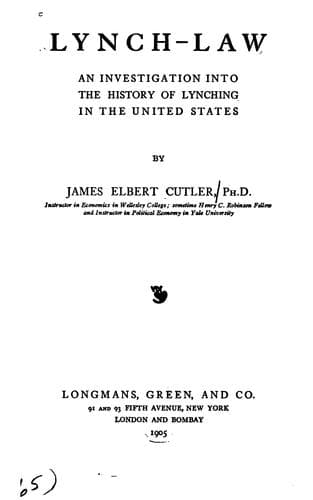
Lynch-law; an investigation into the history of lynching in the United StatesCutler, James Elbert
Philosophy
Lynch-law; an investigation into the history of lynching in the United States
Cutler, James Elbert
Lynching -- United States
In the last analysis lynch-law in this country is without any
justification whatsoever. In a government founded on the idea that
ultimate power and authority shall rest with the people, and in which
sufficient facility has been given to the expression of the collective
will of the people so that the acts of the government, the formulation
of the law, and the administration of justice, ought adequately to
represent this collective will, there is no tenable ground on which to
vindicate the practice of punishing criminals other than by the
regularly constituted courts and the officers of the law. But if
circumstances and conditions be taken into consideration and the history
of the practice carefully noted, it is possible to see how justification
has come about through the different points of view that have been
taken. From the standpoint of the frontiersmen and pioneers summary
procedure in certain cases was wholly justifiable. From the standpoint
of the Southerners during the period of Reconstruction summary procedure
was likewise wholly justifiable. To men living in a community where a
particularly brutal and barbarous crime is committed upon a white person
by a negro, the prompt lynching of the negro, even with some torture and
cruelty, seems entirely defensible. Thus, while we cannot justify the
practice of lynching on any ground whatever, yet the fact remains that
it has been repeatedly justified in one way or another.
CHAPTER VIII
REMEDIES
In the consideration of remedies for lynching it is to the type of
lynch-law procedure which prevails in well settled communities that
attention is to be directed. The type of lynch-law procedure which is
characteristic of a frontier society naturally ceases to exist with the
disappearance of that unorganized form of society. The changed social
conditions incident to an increasing density of the population in a
frontier region, and the establishment of a regular and adequate
judiciary, remove every cause for the existence of the frontier type of
lynch-law. The rapid colonization of the western section of the United
States has thus made that phase of the lynching question no longer a
serious matter. But how to put an end to the practice of lynching in
older communities possessing well established civil regulations is a
problem for which the people of the United States have not yet found a
satisfactory solution.
Public-domain text, read in full here on John Shaqi.
Reviews
Reviews
No reviews yet
Be the first to share your thoughts on this work.
Elsewhere in the archive
Join the Discussion
Join the discussion
Sign in to leave a comment or review.
Sign InorCreate an account