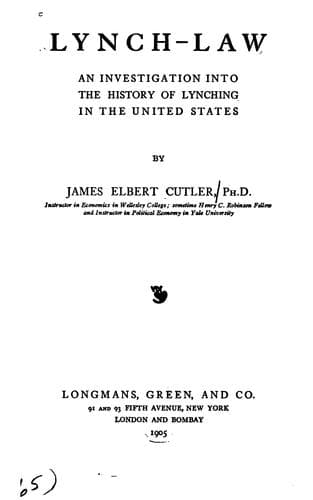
Lynch-law; an investigation into the history of lynching in the United StatesCutler, James Elbert
Philosophy
Lynch-law; an investigation into the history of lynching in the United States
Cutler, James Elbert
Lynching -- United States
As has been pointed out in the preceding chapter, there has been a
strong popular sentiment in the United States, even down to the present
day, excusing and apologizing for lynch-law procedure. On the other
hand, however, there has not been wanting at the same time a spirit of
denunciation and disapprobation[273]; although it was not until the
early nineties, when public attention was directed to the subject by
reason of the occurrence of a number of flagrant cases of lynching, that
determined efforts were put forth to check the practice. Previous to
that time such discussion as there was of the subject brought no
effective restraint to bear on the continuance of the practice, either
because of the intensely partizan character of the discussion as between
the North and the South, or because, while the practice in general was
denounced, particular instances of lynching were excused.[274] The
newspapers and magazines took comparatively little notice of lynchings
until after the year 1890. The newspapers printed accounts of such
occurrences, but the editorial protests were few, and the magazine
literature is almost barren on the subject.
On March 14, 1891, the eleven Italians who were accused of complicity in
the murder of the chief of police of New Orleans were summarily put to
death by a mob. On May 30, 1891, Tump Hampton, colored, was burned at
the stake in the parish of St. Tammany, Louisiana. On January 31, 1893,
a negro by the name of Henry Smith was publicly burned at the stake with
extreme torture at Paris, Texas.[275] Excursion trains were run for the
occasion and there were many women and children in the throng which
watched the sufferings of the victim. These and other instances of a
similar character, together with the increased number of lynchings in
the years 1891, 1892, 1893 (See charts I and IV), focused the attention
of the world upon the American practice of lynching. Italy demanded from
the United States an indemnity for the lynching of the Italians at New
Orleans. Foreign newspapers and periodicals united in heaping abusive
censure upon the United States. Repeated and insistent demands were
made, in America as well as in Europe, that lynchers be brought to
justice and be punished as other murderers are punished.
Public-domain text, read in full here on John Shaqi.
Reviews
Reviews
No reviews yet
Be the first to share your thoughts on this work.
Elsewhere in the archive
Join the Discussion
Join the discussion
Sign in to leave a comment or review.
Sign InorCreate an account