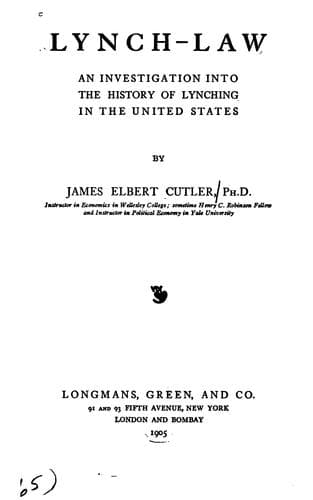
Lynch-law; an investigation into the history of lynching in the United StatesCutler, James Elbert
Philosophy
Lynch-law; an investigation into the history of lynching in the United States
Cutler, James Elbert
Lynching -- United States
Early in the year 1894 a number of the citizens of Louisiana petitioned
the legislature of that State to enact stringent laws against lynching,
but the legislature adjourned without fulfilling the request. A number
of governors at about this time, in messages to the State legislatures,
called attention to the subject and recommended immediate legislation.
Governor Hogg of Texas made the matter of lynching the subject of a
special message, denouncing the practice and strongly urging the
enactment of laws to prevent it. Governor O’Ferrall, in a message to the
legislature of Virginia, recommended that the county in which a lynching
occurs should be required to pay to the State treasury a sum not
exceeding ten thousand dollars for the benefit of the public school
fund. Recommendations of a similar character were subsequently made by
the governors of Maryland and Georgia. Governor Atkinson of Georgia made
the unique recommendation that if an officer in charge of a prisoner is
not required to protect his charge at the hazard of his own life, he
should be required to unshackle the prisoner, arm him, and give him an
opportunity to defend himself. On the assumption that the law’s delay or
slowness is the principal cause for lynching, the governors of a number
of States offered suggestions for a more expeditious judicial procedure.
Of the many measures proposed, however, and of the numerous
recommendations that special legislation be enacted against lynching,
comparatively few have received from the various legislatures sufficient
consideration to lead to the enactment of laws on the subject.[281]
The legislature of Georgia, in the year 1893, passed an act which
authorized “any officer, charged with the duty of preserving the peace
and executing the lawful warrants” of the State, who should have
“knowledge of any violence attempted to be perpetrated upon any
citizen ... by mob violence and without authority of law,” to summon a
posse of citizens, who must respond or be punished for a misdemeanor,
whose duty it should be to use every means in their power, even to the
extent of taking human life, to prevent such violence. It was made a
misdemeanor for said officer to fail to call together a posse in such an
emergency, and citizens who responded were authorized to carry weapons
in the performance of their duties. Any person engaged in “mobbing or
lynching any citizen ... without due process of law” should be arrested
and punished by imprisonment in the penitentiary for not less than one
nor longer than twenty years; and if death resulted from such mob
violence the person causing said death should be subject to indictment
and trial for the offense of murder.[282]
Public-domain text, read in full here on John Shaqi.
Reviews
Reviews
No reviews yet
Be the first to share your thoughts on this work.
Elsewhere in the archive
Join the Discussion
Join the discussion
Sign in to leave a comment or review.
Sign InorCreate an account