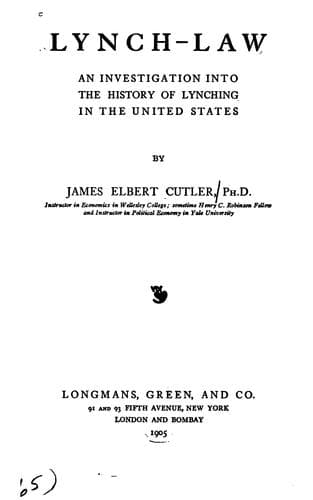
Lynch-law; an investigation into the history of lynching in the United StatesCutler, James Elbert
Philosophy
Lynch-law; an investigation into the history of lynching in the United States
Cutler, James Elbert
Lynching -- United States
In 1896 Ohio entered the list of States that have adopted anti-lynching
laws. This Ohio act gave to lynching its first legal definition. A
_lynching_ and a _mob_ are defined as follows: “That any collection of
individuals, assembled for any unlawful purpose, intending to do damage
or injury to any one or pretending to exercise correctional power over
other persons by violence, and without authority of law, shall for the
purpose of this act be regarded as a ‘mob,’ and any act of violence
exercised by them upon the body of any person, shall constitute a
‘lynching.’” Under this act any person who is taken from the hands of
the officers of justice in any county by a mob, and is assaulted by the
same with whips, clubs, missiles, or in any other manner, may recover
damages from the county to the amount of one thousand dollars; any
person assaulted by a mob and suffering lynching at their hands may
recover from the county in which the assault is made five hundred
dollars, or, if the injury is serious, one thousand dollars, or, if it
result in permanent disability to earn a livelihood by manual labor,
five thousand dollars; and the legal representative of any person
suffering death by lynching at the hands of a mob may recover from the
county in which such lynching occurs the sum of five thousand dollars,
provision being made for the disposition of the recovery in such
instances. Any person suffering death or injury at the hands of a mob
engaged in an attempt to lynch another person is to be deemed within the
provisions of the act, he or his legal representatives having the same
right of action thereunder as one purposely injured or killed by such
mob. An order to the commissioners of a county against which such
recovery may be made, to include the same with costs of action in the
next succeeding tax levy of said county, forms a part of the judgment in
every such case. The county, however, has a right of action to recover
the amount of any judgment against it, including costs, against any of
the parties composing such mob, and any person present with hostile
intent at such lynching is to be deemed a member of the mob and is
liable to such action. In case a mob shall carry a prisoner into another
county, or shall come from another county to commit violence on a
prisoner brought from such county for safe keeping, the county in which
the lynching was committed may recover the amount of the judgment and
costs against the county from which the mob came, unless there was
contributory negligence on the part of the officials of said county in
failing to protect the prisoner or disperse said mob. It is also
provided that nothing in the act shall be held to relieve any person
concerned in such lynching from prosecution for homicide or assault for
engaging therein.[286]
Public-domain text, read in full here on John Shaqi.
Reviews
Reviews
No reviews yet
Be the first to share your thoughts on this work.
Elsewhere in the archive
Join the Discussion
Join the discussion
Sign in to leave a comment or review.
Sign InorCreate an account