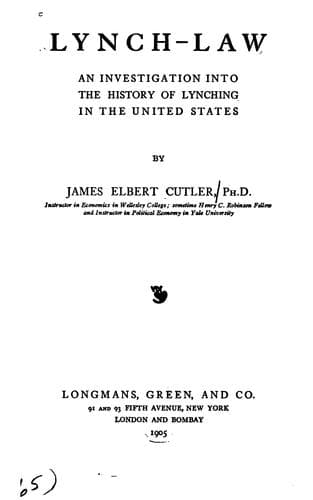
Lynch-law; an investigation into the history of lynching in the United StatesCutler, James Elbert
Philosophy
Lynch-law; an investigation into the history of lynching in the United States
Cutler, James Elbert
Lynching -- United States
By an act of April 25, 1898, it is further provided in the law of Ohio
that whoever shall break into or attempt to break into a jail or any
prison, or to attack an officer, with intent to seize a prisoner for the
purpose of lynching, shall be deemed guilty of a felony, and shall be
confined in the penitentiary for not more than ten years nor less than
one year.[287]
In 1897, Tennessee, Kentucky, and Texas enacted laws directed against
lynching. By the Tennessee act it was made a felony punishable by from
three to twenty-one years’ imprisonment, and by full judgment of infamy
and disqualification, for two or more persons to form or remain in any
conspiracy or combination, under any name, or upon any pretext
whatsoever, to take human life, or engage in any act reasonably
calculated to cause the loss of life; or to inflict corporal punishment
or injury; or to burn or otherwise destroy property or to feloniously
take the same. It was likewise made a felony punishable in like manner
for any person either directly or indirectly to procure or encourage any
one to become or remain a member of any such unlawful conspiracy or
combination; or for any person either directly or indirectly to aid,
abet, or encourage any person to engage or remain in such conspiracies
or combinations, or to aid or abet in the accomplishment of any purpose
or end of such conspiracies or combinations. Any person guilty of any of
these offenses was declared to be incompetent to sit or serve on any
grand or traverse jury, and it was made the duty of the court to
carefully exclude all such persons from the juries, both grand and
petit. It was provided that indictments framed under the act were not to
be held insufficient by reason of the general nature of the charges
preferred, or for embracing more than one of said offenses in the same
indictment, and the act was to “take effect from and after its passage,
the public welfare demanding it.”[288]
Public-domain text, read in full here on John Shaqi.
Reviews
Reviews
No reviews yet
Be the first to share your thoughts on this work.
Elsewhere in the archive
Join the Discussion
Join the discussion
Sign in to leave a comment or review.
Sign InorCreate an account