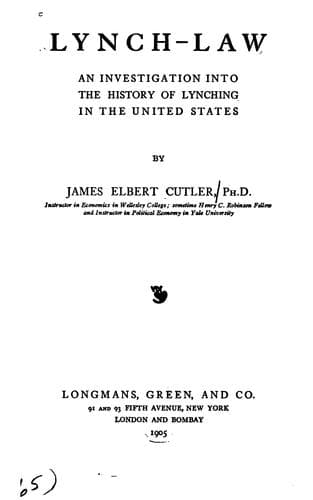
Lynch-law; an investigation into the history of lynching in the United StatesCutler, James Elbert
Philosophy
Lynch-law; an investigation into the history of lynching in the United States
Cutler, James Elbert
Lynching -- United States
the governor’s reward, for the arrest and conviction of any person
violating the act. It was also provided that any person who should send,
circulate, exhibit or put up any threatening notice or letter, should
upon conviction thereof be fined not less than one hundred dollars nor
more than five hundred dollars, and be imprisoned in the county jail not
less than three nor more than twelve months. In any prosecution under
the act it should be no exemption for a witness that his testimony might
incriminate himself; but no such testimony should be used against him in
any prosecution except for perjury, and he should be discharged from all
liability for any violation of the act so necessarily disclosed in his
testimony.[289]
By the Texas law, which was enacted at a special session of the
legislature, it was provided that whenever two or more persons should
combine together for the purpose of mob violence, and in pursuance of
said combination should “unlawfully and wilfully take the life of any
reasonable creature in being by such violence,” such person should be
deemed guilty of murder by mob violence, and upon conviction thereof
should be punished by death or confinement in the penitentiary for life,
or according to the degree of murder, to be found by the jury. It was
made the duty of the district judges to give this law specially in
charge to the grand jury at the beginning of each term of court, and
prosecution for murder under the act might be commenced and carried on
in any county of the judicial district in which the offense should be
committed, except the county of the offense. It was also provided that
if any sheriff, deputy sheriff, constable, chief of police, city marshal
or other officer in the State should permit or suffer any person in his
custody charged with crime to be killed by one or more persons, or
should permit or suffer any such person to be taken from his custody and
killed by one or more persons, he should be deemed guilty of official
misconduct, and be removed from office, proceedings for removal to be
conducted by the attorney-general in accordance with the provisions of
the act, such cases taking precedence in all courts of all other cases.
Pending trial such officer should be temporarily suspended from his
office and should judgment be rendered against him he should not
thereafter be elected or appointed to that office. The final section of
the act reads as follows: “The fact that there is no adequate law in
this State for the suppression of mob violence, creates an emergency and
an imperative public necessity that the constitutional rule requiring
all bills to be read on three several days be suspended, and that this
act take effect and be in force from and after its passage, and it is so
enacted.”[290]
Public-domain text, read in full here on John Shaqi.
Reviews
Reviews
No reviews yet
Be the first to share your thoughts on this work.
Elsewhere in the archive
Join the Discussion
Join the discussion
Sign in to leave a comment or review.
Sign InorCreate an account