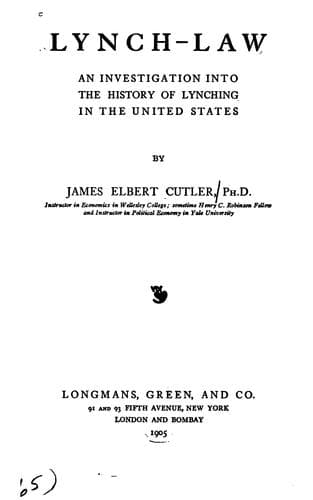
Lynch-law; an investigation into the history of lynching in the United StatesCutler, James Elbert
Philosophy
Lynch-law; an investigation into the history of lynching in the United States
Cutler, James Elbert
Lynching -- United States
By the Kentucky “Act to prevent lynching, &c.,” which was amended by the
omission of three sections and thus re-enacted in 1902, it was provided
that if any two or more persons should confederate or band themselves
together for the purpose of intimidating, alarming, disturbing, or
injuring any persons, or to rescue any person or persons charged with a
public offense from any officer with the view of inflicting any kind of
punishment on them, or with the view of preventing their lawful
prosecution for any such offense or to do any felonious act, they, or
either of them, should be deemed guilty of felony, and upon conviction
should be confined in the penitentiary not less than one nor more than
five years. If any two or more persons should confederate or band
together and go forth for the purpose of molesting, injuring, or
destroying any property, real or personal, of another person, persons or
corporation, whether the same be injured, molested or damaged or not,
they should be guilty of a felony punishable by a like penalty; and if
any injury should result to the person or property of any person or
persons, by reason of any such unlawful acts, any one participating in,
or aiding or abetting, such unlawful acts should be guilty of a felony,
and upon conviction should be confined in the State penitentiary not
less than one nor more than fifteen years, unless death should result,
in which case the penalty for such offense should be that prescribed by
law for murder. It was made no mitigation of the offense for any one
upon his trial, that he may have acted through heat or passion, or that
he may have acted without malice, and the judge trying the case should
so instruct the jury in writing. It was provided, also, that any officer
or person having the custody of a prisoner should have the power and it
should be his duty to summon to his aid as many of the able-bodied male
citizens of his county as might be necessary to protect such prisoner,
any person who should fail or refuse to respond to such summons being
liable to a fine of not less than one hundred dollars nor more than five
hundred dollars; and when any officer in charge of a jail had reasonable
grounds to believe that said jail would be attacked by a mob or persons
confederated or banded together for the purpose of inflicting violence
upon any inmate of said jail, he was authorized, in his discretion, to
arm said threatened inmates, with a view to their own protection.
Authority was given the governor to offer a reward for the apprehension
and conviction of any offender of this law in any sum not exceeding five
hundred dollars, and also to employ detectives, in his discretion, not
exceeding two at any one time, provided the cost thereof should not
exceed three thousand dollars in any one year. The judge of the county
court of any county in which this law should be violated was also given
power to offer a reward not exceeding two hundred dollars, or supplement
Public-domain text, read in full here on John Shaqi.
Reviews
Reviews
No reviews yet
Be the first to share your thoughts on this work.
Elsewhere in the archive
Join the Discussion
Join the discussion
Sign in to leave a comment or review.
Sign InorCreate an account