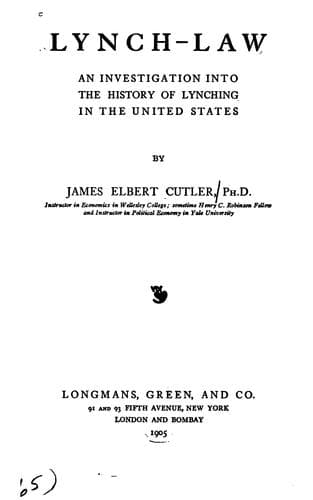
Lynch-law; an investigation into the history of lynching in the United StatesCutler, James Elbert
Philosophy
Lynch-law; an investigation into the history of lynching in the United States
Cutler, James Elbert
Lynching -- United States
In 1901 the Indiana act received the following important amendment: “If
any person shall be taken from the hands of a sheriff or his deputy
having such person in custody, and shall be lynched, it shall be
conclusive evidence of failure on the part of such sheriff to do his
duty, and his office shall thereby and thereat immediately be vacated,
and the coroner shall immediately succeed to and perform the duties of
sheriff until the successor of such sheriff shall have been duly
appointed, pursuant to existing law providing for the filling vacancies
in such office, and such sheriff shall not thereafter be eligible to
either election or reappointment to the office of sheriff: _Provided,
however_, That such former sheriff may, within ten days after such
lynching occurs, file with the governor his petition for reinstatement
to the office of sheriff, and shall give ten days’ notice of the filing
of such petition to the prosecuting attorney of the county in which such
lynching occurred and also to the attorney general. If the governor,
upon hearing the evidence and argument, if any, presented, shall find
that such sheriff has done all in his power to protect the life of such
prisoner and performed the duties required of him by existing laws
respecting the protection of prisoners, then such governor may reinstate
such sheriff in office....”[292]
In 1899 the legislature of Michigan enacted a law against lynching
modelled on the Ohio act of 1896, but in 1903 this law was
repealed.[293]
In the constitution which was adopted by Alabama in 1901 this provision
was made in regard to the responsibility of sheriffs: “Whenever any
prisoner is taken from jail or from the custody of the sheriff or his
deputy, and put to death, or suffers grievous bodily harm, owing to the
neglect, connivance, cowardice or other grave fault of the sheriff, such
sheriff may be impeached under Section 174 of this Constitution. If the
sheriff be impeached and thereupon convicted, he shall not be eligible
to hold any office in this State during the time for which he had been
elected to serve as sheriff.”[294]
In response to a general and a special message from the governor of West
Virginia calling attention to the fact that within a year several
persons had been “brutally murdered at the hands of riotous and lawless
mobs,” the legislature of that State adopted a joint resolution on
February 3, 1903, condemning “such riotous and lawless acts” and
empowering the governor, by and with the aid and advice of the
attorney-general, to investigate and place on foot such means as in his
judgment were necessary to bring the guilty parties to justice.[295]
Public-domain text, read in full here on John Shaqi.
Reviews
Reviews
No reviews yet
Be the first to share your thoughts on this work.
Elsewhere in the archive
Join the Discussion
Join the discussion
Sign in to leave a comment or review.
Sign InorCreate an account