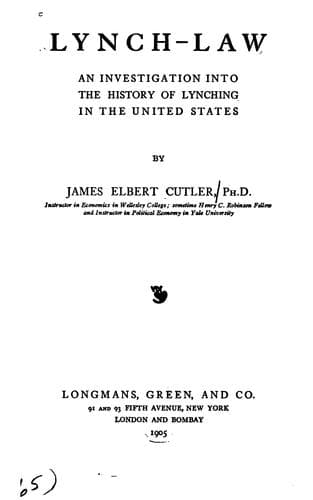
Lynch-law; an investigation into the history of lynching in the United StatesCutler, James Elbert
Philosophy
Lynch-law; an investigation into the history of lynching in the United States
Cutler, James Elbert
Lynching -- United States
One case has arisen under the Indiana act as amended in 1901. On
November 20, 1902, James Dillard, a negro who had committed the crime of
rape, was taken from the custody of John S. Dudley, the sheriff of
Sullivan County, Indiana, and “lynched by hanging until dead.” Dudley
had been elected sheriff at the general election held in November, 1900,
and William P. Maxwell had been elected coroner of Sullivan County. At
the general election held in November, 1902, each had been elected as
his own successor. On the day following the lynching of Dillard,
Governor Durbin notified Maxwell that the office of sheriff of Sullivan
County was vacant, and that he, as coroner, under the law succeeded to
the duties of the office. Maxwell thereupon demanded of Dudley the
possession of the office. This Dudley refused to give, and within ten
days after the lynching occurred, as provided for in the statute, filed
with the governor a petition for reinstatement in the office. After
hearing the petition and the evidence in support of it, Governor Durbin
denied the petition and refused to reinstate him. Governor Durbin then
notified the board of commissioners of Sullivan County of the vacancy in
the office of sheriff and suggested that the board appoint a successor
to Dudley. The board of commissioners took no action, however, and
Maxwell brought suit under a _quo warranto_ statute, to oust Dudley from
the office. In the circuit court of Sullivan County a judgment for the
defendant was rendered, and on an appeal to the supreme court of Indiana
the judgment of the circuit court was affirmed. The issues in the case
were purely questions of law, it being held that Maxwell did not have
ground for action under the _quo warranto_ statute, and the supreme
court expressed no opinion on the constitutionality of the amendatory
act of 1901.[308]
Thus, the outcome of this case was, in effect, to nullify the operation
of the statute which removes a sheriff from office when he allows a
prisoner to be taken from his custody and lynched. The fact that Dudley
continued to exercise the duties of his office after the lynching
occurred, and successfully refused to vacate the office in response to
the demands of the coroner, indicates that public sentiment in the
community did not support the execution of the provisions of the law.
Newspaper reports of the case intimate, however, that politics entered
into the question to some extent.
Public-domain text, read in full here on John Shaqi.
Reviews
Reviews
No reviews yet
Be the first to share your thoughts on this work.
Elsewhere in the archive
Join the Discussion
Join the discussion
Sign in to leave a comment or review.
Sign InorCreate an account